Our blog

Latest news
& events

Florida TRIM notice on a counter, the start of a TRIM notice appraisal and Collier County VAB petition
Your Naples TRIM Notice Starts a 25-Day Clock

The Notice of Proposed Property Taxes hits Collier County mailboxes in the second half of August. The clock starts the day it is mailed, not the day it is opened. A TRIM notice appraisal answers the one question the Value Adjustment Board will actually decide. What was this property worth on January 1? For 2026, Collier’s petition deadline is September 11. That leaves attorneys and owners about a week to decide whether the number deserves a fight.

By the end of this article, you’ll know:

  • The 2026 Collier County filing deadline, fee, and what has to be paid to keep a petition alive
  • Who carries the burden at the VAB and what the evidence has to prove
  • How a January 1 retrospective appraisal is built to meet that burden

The 25-Day Clock Behind a TRIM Notice Appraisal

Florida law gives a taxpayer until the 25th day after the property appraiser mails the notice to petition the Value Adjustment Board on a valuation issue. That rule sits in section 194.011 of the Florida Statutes. The board cannot extend it. Still, late petitions are possible. They need a good cause statement, and the VAB attorney decides whether to accept them.

Collier County has published its own date. The Collier Clerk’s Value Adjustment Board page sets the 2026 deadline at September 11. That means 5 p.m. in the office at 3299 Tamiami Trail East, or 11:59 p.m. online. The filing fee is $50 per petition per parcel for most petition types, payable at filing. The clerk rejects a petition without the fee. If the petition is not in by September 11, the 2026 value stands unless the owner goes to circuit court instead.

One more requirement trips up owners who file and forget. A petitioner challenging assessed value must pay at least 75 percent of the ad valorem taxes before they become delinquent, less the early payment discount. Miss that payment and the board must deny the petition by written decision.

What the Value Adjustment Board Weighs

The statute stacks the deck in a specific way. Under section 194.301, the property appraiser’s assessment is presumed correct once the appraiser shows it followed section 193.011 and professionally accepted appraisal practices, including mass appraisal standards. The challenger then carries the burden. By a preponderance of the evidence, the petitioner has to show the assessed value does not represent just value as of January 1. Or, that the appraiser reached it by practices not applied to comparable property in the county.

So the argument is never that the number feels high. It is that competent, substantial evidence in the record supports a different number under the appraiser’s own criteria. When the petitioner clears that bar, the board or special magistrate sets the value from the evidence in the record. When the record is thin, the matter can go back to the property appraiser with directions. It does not go to the owner’s preferred number.

Collier County, like every Florida county over 75,000 people, uses special magistrates to hear valuation petitions. A magistrate on a real estate valuation must be a state-certified appraiser with at least five years of experience. So the person reading the report is not a layperson. Someone who does this work will judge every adjustment, every comparable, and every reconciliation.

What a January 1 Appraisal Has to Do

Florida assesses as of January 1. So the appraisal is retrospective by definition. By the time a TRIM notice arrives in August, eight months of sales have closed that cannot set a January value. So the report has to reconstruct the market as it stood on the first of the year. That means sales that bracket the date, and market conditions adjustments that run to January 1 rather than to the inspection date.

The evidence exchange is where good reports separate from adequate ones. Under section 194.011(4), the petitioner must give the property appraiser a list of evidence, copies of every document the board will see, and a witness summary. All of it is due at least 15 days before the hearing. The property appraiser owes the petitioner the same on the same timeline, including the property record card. Read that card closely. Errors in living area, quality grade, or land size are among the cleanest grounds for a value change, and the easiest for a magistrate to accept.

Our piece on tax appeal appraisal evidence covers the Cook County version of these rules. The Florida version has its own quirks, and the largest is who can appear. Section 194.034 lets a Florida Bar attorney, a licensed real estate appraiser, a licensed broker, or a CPA represent the taxpayer. So can anyone holding a written authorization or power of attorney. In practice, the appraiser who wrote the report can present it, and an attorney can cross-examine the property appraiser’s staff on theirs.

A separate rule matters when choosing the appraiser. An appraisal cannot come in as evidence in any year its author serves as a special magistrate to that same board. Ask before engaging.

Where the Value Change Actually Reaches the Bill

For high-value Naples property, check the arithmetic before anyone files. A lower just value does not always mean a lower bill. Consider a hypothetical homesteaded Port Royal house with a just value of $6,000,000 on the notice. The Save Our Homes cap has held its assessed value near $3,500,000. So cutting just value to $5,400,000 changes nothing on this year’s bill. The capped assessed value still sits far below either number.

Now consider a second home on the Gulf, bought in 2024, with no homestead. Its assessed value tracks just value, subject to the ten percent non-homestead cap. So a $600,000 reduction in just value flows into taxable value. At a hypothetical combined millage near one percent, that is roughly $6,000 a year, every year the reduction holds. The same logic applies to a recently purchased homestead where the cap reset at sale. It applies to rental, commercial, and vacant land too. That is why the first question we ask a Naples owner is not what the notice says. It is whether the property is capped, and by how much.

The appraisal itself has to be built for the magistrate, not for the owner. We prepare Naples appraisals with a January 1 effective date and adjustments a certified appraiser can trace. Comparable sales are confirmed with the parties where possible. A report that leans on listing prices, or on sales that closed in June, will not survive the presumption of correctness. Nor should it.

Decisions, Appeals, and the Circuit Court Fallback

Once a petition is in, the clerk schedules the hearing at least 25 days out and notifies the petitioner in writing. Either side may reschedule once for good cause. After the hearing, the magistrate issues a recommended decision with findings of fact and conclusions of law. The board then renders the final written decision. If the property appraiser loses by more than a set variance, five percent on assessments over $2.5 million, the appraiser may take the board to circuit court. A taxpayer may bring a circuit court action too, generally within 60 days of the roll’s certification or of the VAB decision.

That fallback is why the VAB record matters even when the hearing goes badly. A well-documented appraisal in the VAB file gives the attorney a foundation for the circuit court action. A weak one, by contrast, gives opposing counsel a preview.

File First, Then Build the Record

With a week left, the sequence is short. Confirm the parcel’s assessed and just values on the notice and whether a cap is doing the work. If the just value looks wrong and the reduction would reach the bill, file online by September 11 with the $50 fee. Then order the January 1 appraisal. The report does not have to be in hand at filing. It has to be complete and in the property appraiser’s hands 15 days before the hearing. In practice, filing buys the time to do it right. Missing the date takes that time away for a full year.

Is the Collier Value on Your Client’s TRIM Notice Right?

PahRoo prepares January 1 retrospective appraisals for Collier County VAB petitions, built to the evidence exchange rules and ready for a certified-appraiser magistrate.

Beat the VAB Deadline

Frequently Asked Questions

How long do I have to appeal after a TRIM notice in Florida?

Twenty-five days from the date the property appraiser mails the notice, under section 194.011 of the Florida Statutes. The exact date is printed on the notice and published by the county clerk. Collier County’s 2026 deadline is September 11. The board cannot extend it, and a late petition needs a good cause statement the VAB attorney accepts.

What is a TRIM notice?

TRIM stands for Truth in Millage. The Notice of Proposed Property Taxes shows the property appraiser’s just, assessed, and taxable values as of January 1, the exemptions applied, the proposed millage rates from each taxing authority, and the resulting estimated tax. It is not a bill. It is the notice that starts the appeal window.

What evidence does the Value Adjustment Board accept?

Any evidence that bears on just value as of January 1, including an independent appraisal, comparable sales, photographs, condition reports, and corrections to the property record card. Under section 194.011(4) the petitioner must provide the property appraiser a list of evidence, copies of all documents, and a witness summary at least 15 days before the hearing.

How much does a Collier County VAB petition cost?

The Collier Clerk charges $50 per petition per parcel for most petition types, and $15 for portability petitions, payable at filing. The petition is invalid if the fee is not paid. Professional costs, such as an independent appraisal or attorney representation, are separate.

Do I have to pay my property taxes while my VAB petition is pending?

Yes, in part. Under section 194.014, a petitioner challenging assessed value must pay all non-ad valorem assessments and at least 75 percent of the ad valorem taxes before the taxes become delinquent. If that payment is not made, the board must deny the petition. Any overpayment found later is refunded with interest.

January 1 Appraisals for Collier County Petitions

Property tax attorneys and Naples owners bring in PahRoo Appraisal & Consultancy when a TRIM notice value does not match the market. Our MAI and SRA designated team prepares retrospective appraisals as of the January 1 lien date across our appraisal service lines, and our property tax appeal FAQs answer the questions owners raise first. To discuss a Collier County parcel before the filing deadline, contact our team.

Signed quitclaim deed on a desk, the kind of divorce transfer an appraiser values at the transfer date
Quitclaim Deed Divorce Transfers and What Appraisers See

A quitclaim deed takes five minutes to sign and a few days to record. In a divorce, that speed is the problem. A quitclaim deed divorce transfer can move a house, a rental building, or a vacant lot to a relative or a new LLC. It can happen before the other spouse knows the marriage is ending. When that happens, the attorney’s first question is usually about the law. My first question is about the date. Everything the court eventually weighs depends on what the property was worth the day it changed hands.

By the end of this article, you’ll know:

  • What a quitclaim deed does, and why it shows up in divorce files
  • The specific things an appraiser checks when a property was transferred mid-case
  • How a transfer-date appraisal gives counsel a number to argue from

What a Quitclaim Deed Divorce Transfer Actually Does

A quitclaim deed conveys whatever interest the signer holds in a property, with no promise that the interest is any good. It is the simplest deed there is. Spouses use it every day for legitimate reasons. Most often, one spouse keeps the house after a marital home buyout and the other signs off.

The trouble starts when the deed runs the other direction, away from the marital estate. A spouse signs the family’s two-flat over to a sibling for ten dollars. A vacant lot moves into a newly formed LLC. Title to a lake house lands with an adult child from a first marriage. On paper the property is gone. In the market, nothing about the property changed that day except the name on title.

That gap is where an appraiser earns a fee. The Illinois Uniform Fraudulent Transfer Act treats real estate as transferred once the conveyance is perfected. It then measures the remedy against the asset’s value at the time of the transfer. Whether that Act, the dissipation rules in the divorce statute, or some other theory applies is the attorney’s call. Each one, though, turns on the same fact: what the property was worth on the transfer date.

Why the Transfer Date Becomes the Effective Date

In most divorce appraisals the court or the parties set the effective date, and it is often the trial date. We covered that choice in our piece on the date of value in a divorce appraisal. A transferred property breaks the pattern. The question is no longer what the house is worth today. It is what walked out of the estate, and when.

So the appraisal is retrospective. I value the property as of the deed’s signing or recording date, using only sales and market conditions that existed then. Sometimes the case also needs a current value, because the court may order the property returned or its value charged against the transferring spouse. That is a second effective date and a second analysis. Ordering both at once costs less than ordering the second one later.

Under USPAP, a retrospective value has to rest on information a market participant could have known as of the effective date. A sale that closed two months after the deed cannot support the value at the deed. Counsel should expect the report to say so plainly.

What an Appraiser Looks For in a Mid-Divorce Transfer

The deed itself is the first exhibit. I read the recorded instrument, not a summary, because the details matter. The grantee’s name tells me whether the property went to an insider: a relative, a business the spouse controls, a close friend. The stated consideration, along with the transfer tax declaration or exemption stamp attached to it, tells me what value reached the county’s records. A deed reciting ten dollars for a $600,000 two-flat is not evidence of value. It is evidence that value was not exchanged.

Then I look at what happened after the transfer. Who is living in the property? Who collects the rent and pays the taxes and insurance? If the transferring spouse still holds the keys and the bank account, the deed changed the name on title and little else. That pattern, retained possession after a transfer to an insider for nominal consideration, appears on the statute’s own list of factors a court may consider. I do not decide whether it is fraud. I do document it, because those facts sit inside the appraisal’s scope.

The property’s condition on the effective date matters too. Photos from a prior listing, a refinance appraisal, permit history, or the other spouse’s recollection all help reconstruct what the building looked like that day. They also show whether the deed came before or after a major repair, a fire, or a new roof.

Lenders meet the same deed from the other side. When one spouse tries to refinance the marital home to fund a buyout, a recent quitclaim to a relative or an LLC surfaces in the title search. Underwriting stalls until the ownership question is settled. A transfer-date appraisal already in the file answers the value half of that question before the loan officer has to ask.

Finally, I check the encumbrances. A property quitclaimed subject to a mortgage moves equity, not the whole value. The report separates the market value of the real estate from the debt against it. That way the attorney sees the actual dollars that left the estate. The same records we recommend in our guide to disputed property value in an Illinois divorce do double duty here.

Reconstructing the Market at the Transfer Date

A retrospective analysis takes more work than a current one, and the reasons are practical. Comparable sales have to reflect the record as it stood then, before later sales and later price movement crept in. Interest rates and inventory as of that date, not today’s, frame the adjustments. When the transfer happened years earlier, archived MLS records, county records, and old listing photos become the evidence base.

The result is a value the court can hold up against the consideration on the deed. A $600,000 building conveyed for ten dollars to a brother-in-law tells its own story once the number is on the table. So does a building conveyed for $580,000 to an unrelated buyer. That one looks like a real sale at a modest discount rather than a stripped asset. The appraisal does not argue the point. It removes the guesswork about the size of the gap.

Where the Appraiser Stops and the Attorney Starts

I establish value at the date the case needs. I document the facts around the transfer that fall within an appraiser’s competence. And I stand behind the report on the witness stand. Whether the deed was fraudulent, dissipative, or voidable, and what remedy the court should order, is legal characterization. That belongs to counsel and the judge. A report that wanders into it loses credibility fast, and opposing counsel will notice.

The same goes for reversing a transfer. Courts have tools to unwind a bad conveyance or charge its value against the party who made it. Which tool fits is a legal question. The appraiser’s job is to make sure that whatever tool the court reaches for, the value it applies is the right one.

Order the Transfer-Date Appraisal Before Discovery Closes

When a transferred property surfaces in a case, pull the recorded deed and the transfer declaration first. Confirm the exact date. Decide with the appraiser whether the case needs one effective date or two. Then order the retrospective appraisal early enough to disclose it with your expert designations. A value produced the week before trial draws the hardest attack. Fix the number to the date, and the rest of the argument has a foundation.

Did a Property Leave the Estate Before the Filing?

PahRoo prepares transfer-date and current-value appraisals for real estate quitclaimed before or during a divorce, documented for discovery and testimony.

Value the Transferred Property

Frequently Asked Questions

What is a quitclaim deed in a divorce?

A quitclaim deed transfers whatever ownership interest the signer holds in a property, with no guarantee of title. In divorce it is commonly used to move the marital home to the spouse who keeps it after settlement. Before or during the case, it can also shift property out of the marital estate to a relative or an entity.

Can a spouse transfer property before a divorce?

A spouse can sign and record a deed, but that does not settle whether the transfer holds up. Courts can examine transfers made in anticipation of divorce, and Illinois law allows dissipation and fraudulent transfer claims in the right circumstances. Whether a given transfer is open to challenge is a legal question for the attorney.

How is a transferred home valued in a divorce?

With a retrospective appraisal. The appraiser sets the effective date at the date of the deed. The value then rests only on sales and market conditions that existed at that time. If the court may also need a current value, the same assignment carries a second effective date.

Is a pre-divorce property transfer reversible?

Sometimes. Courts have remedies that can unwind a transfer or charge its value against the spouse who made it. Fraudulent transfer law provides its own relief. Which remedy applies, and whether one applies at all, depends on the facts and the attorney’s argument. The appraisal supplies the value that sets the size of the remedy.

What is a fraudulent conveyance?

In general terms, a transfer made to hinder, delay, or defraud a creditor. It also covers a transfer made without reasonably equivalent value while the transferor was in financial trouble. Illinois codifies this in the Uniform Fraudulent Transfer Act. Deciding whether a specific deed meets that definition is the court’s job, informed by counsel and by the appraised value at the transfer date.

Appraisal Support When a Deed Changes Hands Mid-Case

Attorneys across Cook County, Dallas-Fort Worth, Philadelphia, Phoenix, and Naples bring PahRoo Appraisal & Consultancy into cases where a property changed hands at the wrong moment. Our MAI and SRA designated team prepares retrospective and current-value divorce appraisals built for discovery and cross examination. Start with our overview of appraisals in divorce proceedings, review our residential appraisal services, or contact us with the recorded deed in hand.

Newly built commercial property valued through a cost approach commercial appraisal
The Sales Comparison and Cost Approaches in Commercial Appraisal

Two of the three approaches to value get less attention than they deserve. The income approach dominates most commercial reports, so brokers and lenders tend to skim the rest. That is a mistake on the wrong property. A cost approach commercial appraisal is often the only credible path to value on a new building or a special-use facility. And the sales comparison approach tells you whether a buyer’s likely price lines up with what the income says. So here is how each one works, when it leads, and what to check when you read one.

By the end of this article, you’ll know:

  • How the sales comparison approach is adapted for commercial property with thin data
  • What a cost approach actually adds up, and how depreciation is measured
  • When each approach should carry the weight, and how to check that it does

How the Sales Comparison Approach Works for Commercial Property

The sales comparison approach values a property by what similar properties sold for, adjusted for the differences. Residential appraisers usually have several nearby sales from the last few months to work with. Commercial appraisers rarely have that luxury. A submarket may produce four flex-industrial sales in two years, and none of them is a twin of the subject.

So the method bends to fit the data. The search area widens, sometimes to the whole metro. The time window stretches too. Then a market conditions adjustment has to account for price movement between the comparable’s sale and the effective date. The unit of comparison also changes with the property type: price per square foot for industrial and office, price per unit for apartments, price per net rentable square foot for self-storage, price per key for hotels.

Adjustments are where the work lives. Location, size, age and condition, construction quality, ceiling height, loading, parking ratio, and lease status all get weighed. Where possible, paired sales or market participants support each adjustment, not the appraiser’s instinct. A grid of round-number adjustments with nothing behind them is the first thing a reviewer questions. Our overview of the three approaches to value covers how they fit together. This piece goes deeper on the two that get skipped.

One more commercial wrinkle. A sale of a leased building reflects the leases, not just the bricks. A comparable with a credit tenant on a ten-year lease is not the same as a vacant building of the same size. So the appraiser has to know the terms of each sale. Confirming them with a broker or a principal is part of the job, not a courtesy.

What a Cost Approach Commercial Appraisal Adds Up

The cost approach asks a simple question. What would it cost to buy the land and build this property new today, less the value the existing building has lost? The formula runs: site value, plus replacement cost new, plus entrepreneurial incentive, minus accrued depreciation.

Site value comes from land sales, so the cost approach starts with its own small sales comparison analysis. Replacement cost new is the cost to build a modern equivalent with the same utility, not an exact copy. That distinction matters on older buildings. Reproducing a 1920s masonry warehouse with its original details would cost far more than replacing its function with a tilt-up box. Buyers pay for function. Cost figures come from published cost services, contractor bids, and recent local projects. They cover direct costs such as labor and materials, plus indirect costs such as architecture, permits, financing, and lease-up.

Entrepreneurial incentive is the profit a developer would need to take on the project. Leaving it out understates cost. Including it without market support overstates it. Either way, it should be visible in the report, not buried.

The Uniform Standards of Professional Appraisal Practice require a developed cost approach to address site value, cost new, and accrued depreciation. That last item is where most of the judgment sits.

How Depreciation Is Measured

Depreciation in an appraisal is not the tax schedule. It is the gap between what the building would cost new and what it contributes to value today. It comes in three forms.

Physical deterioration is wear. Roofs age, parking lots crack, mechanical systems reach the end of their lives. Some of it is curable, meaning the cost to fix is less than the value it adds back, and some is not. Functional obsolescence is a design problem. Think 14-foot clear height in a market that wants 32 feet, or too little power for modern loads. External obsolescence comes from outside the property line, such as rising submarket vacancy or a highway interchange that moved the traffic.

Appraisers measure depreciation several ways. The age-life method compares effective age to total economic life. Market extraction pulls depreciation out of actual sales. Subtract land value from the sale price, then compare what remains to cost new. Breakdown analysis prices each form of depreciation separately. On a new building the number is small and easy to support. On a 45-year-old building it can exceed half of cost new. The further the estimate has to reach, the less weight the approach deserves.

A Worked Example on an Industrial Building

Consider a 36,000 square foot warehouse, twelve years old, in a stable industrial submarket. The cost approach might run like this:

  • Site value from land sales: $900,000
  • Replacement cost new, including indirect costs and entrepreneurial incentive: $4,200,000
  • Less accrued depreciation at 30 percent: $1,260,000
  • Depreciated cost of improvements: $2,940,000
  • Indicated value by the cost approach: $3,840,000

Now the sales comparison approach. Four metro warehouse sales, adjusted for location, age, clear height, and market conditions, bracket $98 to $112 per square foot. The appraiser reconciles to $105 per square foot, which indicates $3,780,000.

The two approaches land within two percent of each other. That agreement is itself evidence. When the approaches disagree by 20 percent, something is wrong with an input, and the reconciliation should say which one.

When There Are No Comps

Some properties have almost no market. A fire station, a school, a church, or a purpose-built manufacturing plant may trade once in a generation, and often not as the same use. These are special-use properties. Income struggles because there is no rental market. Sales comparison struggles because there are no sales. Cost is usually the only approach with real evidence behind it.

New construction is the other clear case. A building completed last year has minimal depreciation, current cost data, and a land value that can be supported. Lenders financing construction lean on cost for exactly that reason. Still, they expect it to reconcile against the completed value from the other approaches.

Cost also plays a quieter role on ordinary income property. When the income approach lands well below what it would cost to build, new supply is not feasible at current rents. That gap tells a lender something about competitive risk. It tells a broker something about how long existing stock will hold its pricing. An appraiser who develops cost even when it does not lead is giving you that signal for free.

Where Each Approach Earns Its Weight

On a stabilized multi-tenant building, income leads and sales comparison supports it. On an owner-occupied building with an active market, sales comparison may lead. Owner-user buyers think in price per square foot, not cap rate. On a special-use facility or a building still in its first year, cost leads. Our piece on what drives office building value shows the income-led case in detail.

The weighting is a judgment the appraiser has to explain. A report that develops all three approaches and then averages them has not reconciled anything. A report that leans on one approach should say why its evidence is stronger. Read the reconciliation with that question in mind, and you will know quickly whether the report was built or assembled.

Ask Which Approach Carried the Weight, and Why

Before relying on a commercial value, find the reconciliation and check three things. First, was the leading approach the right one for this property type and its data? Second, do the sales adjustments and the depreciation estimate have market support the report actually shows? Third, do the approaches agree, and if not, is the gap explained? If any answer is no, the cover-page number rests on less than it appears to. So ask the appraiser. A good one will walk you through it.

Selling a Building With No Clean Comps?

PahRoo develops the sales comparison and cost approaches with the support shown, so brokers can price with confidence and lenders can see the evidence.

Scope a Commercial Appraisal

Frequently Asked Questions

When is the cost approach used in commercial appraisal?

It leads on new or nearly new buildings, where depreciation is small and costs are current, and on special-use properties such as schools, churches, and purpose-built plants that have few or no comparable sales. On ordinary income property it usually supports the conclusion and serves as a feasibility check against the income approach.

How does the sales comparison approach work for commercial property?

The appraiser locates sales of similar properties, confirms the terms of each sale, and adjusts for differences in location, size, age, condition, lease status, and market conditions. Because commercial sales are scarce, the search often covers a wider area and a longer time period, and the unit of comparison changes by property type.

Why is the cost approach used for special-use property?

Special-use properties rarely sell and rarely rent, so the sales comparison and income approaches have little evidence to work with. The cost approach can still be developed from land sales, current construction costs, and a supported estimate of depreciation, which makes it the most credible path to value for those properties.

How is depreciation measured in a commercial appraisal?

Appraisal depreciation is the gap between cost new and the building’s current contribution to value. It includes physical deterioration, functional obsolescence, and external obsolescence. Appraisers estimate it through the age-life method, market extraction from actual sales, or a breakdown of each form, and the estimate should be supported in the report.

Are there enough comps for commercial property?

Often not many. A submarket may produce only a handful of relevant sales over two years. Appraisers widen the geography, extend the time window, and adjust for market conditions to compensate. When comparable sales are too thin to support a conclusion, the report should say so and lean on the cost or income approach instead.

Sales, Cost, and Income Analysis From One Appraisal Team

PahRoo Appraisal & Consultancy develops all three approaches to value on commercial assignments across Chicago and Cook County, Dallas-Fort Worth, Philadelphia, Phoenix, and Naples, from single-tenant industrial to special-use facilities. Our commercial appraisal services page covers scope and property types, our guide to net operating income explains the income side, and you can contact our team or call 773-388-0003 to discuss a specific property.

Homes for sale on a Chicago street during the fall 2026 housing market
Fall 2026 Housing Market Brings Buyers More Choices

Buyers heading into the fall 2026 housing market will find more homes to choose from than they did a year ago. Prices, on the other hand, are barely moving. The national numbers for mid-August describe a market that is loosening slowly rather than breaking, and Chicago is quietly running against the grain.

By the end of this article, you’ll know:

  • Where inventory, sales, and prices stand as of mid-August 2026
  • Why Chicago home values are still rising while the national market flattens
  • What a flat market with heavy price cutting means for your home’s appraised value

What the Fall 2026 Housing Market Numbers Show

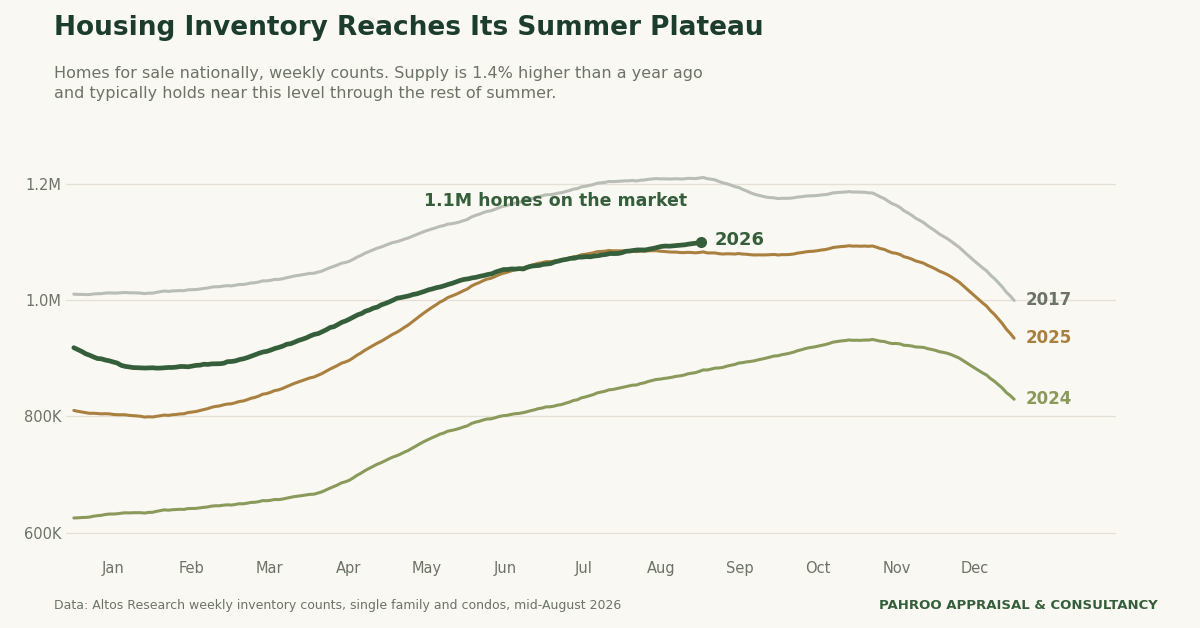
Four numbers tell the story. Mortgage rates climbed about 30 basis points in July and now sit near their highest levels of the year. Pending home sales came in around 77,000 new contracts in a recent week. That is down 3.9 percent from a year ago. Total inventory sits just above 1.1 million homes, about 1.4 percent higher than last year. The national median price for single family homes is holding near $399,000, essentially flat year over year.

Fall 2026 housing market inventory at 1.1 million homes compared to 2025, 2024, and 2017

The weekly tracking comes from Altos Research, which counts every active listing in the country. The longer arc shows up in the Federal Reserve’s national active listing data as well: supply has been rebuilding for several years, but it is still climbing gradually, not flooding the market.

Compare this to September 2023, when rates jumped 70 basis points in a single month and demand fell hard. Rates have moved a similar amount this time, but over five months. So the squeeze is real, just slower and easier to miss.

Why Chicago Is Running Against the National Grain

National averages hide a lot. Markets with plenty of supply, including Las Vegas and Seattle, are seeing slightly negative price movement. Recovering metros such as San Francisco and Miami have flipped back to appreciation. Tight supply markets, and Chicago is the clearest example, are still posting gains.

Chicago never overbuilt during the pandemic run, and listing activity here has stayed thin relative to demand. When few homes come to market, even modest buyer interest keeps prices firm. That is why a homeowner in Portage Park or Evanston can still see values inching up while the national headline reads flat.

In practice, this split means national coverage tells you very little about your own block. A Chicago real estate appraisal works from local sales, local supply, and the specific condition of your property, which is where the real answer lives.

Price Reductions Are the Early Warning System

One national figure deserves special attention: 41.7 percent of homes on the market have taken a cut from their original list price. At the current pace, that share will pass last year’s level sometime in September.

Price reductions matter because they lead sale prices by roughly three to six months. Sellers adjust their asking price before closed sales show any weakness. So a rising reduction rate in August hints at softer closing prices heading into winter, even while the median holds steady today.

Still, a price cut is not a crash signal. Reduction rates ran at similar levels last fall, and national prices finished the year flat rather than down. The takeaway is direction, not disaster: sellers have less pricing power than the headline median suggests.

What a Flat Market Means for Your Home’s Appraised Value

A flat market is deceptively tricky for valuation. When prices rise or fall steadily, recent sales point clearly in one direction. When the market goes sideways with four in ten listings cutting price, the spread between asking prices and closed prices widens. Two similar homes on the same street can sell months apart at noticeably different numbers.

This is where automated estimates struggle. Algorithms lean heavily on list prices and older sales, and both are unreliable guides right now. An appraiser instead works from verified closed sales, adjusts for condition and timing, and weighs how long comparable homes actually sat before selling.

For homeowners, the flat national picture cuts both ways. If you are selling, pricing to the market on day one matters more than usual, because chasing the market down with reductions costs both time and money. The stakes rise further in an estate, a divorce, or a tax appeal. In those settings, a defensible number matters most exactly when public data sends mixed signals. Our residential appraisal services exist for exactly these moments.

Waiting for Lower Rates Carries Its Own Cost

Plenty of buyers are sitting out this fall, waiting for rates to drop. That is understandable, but the trade is rarely free. When rates fall, sidelined demand tends to return quickly, and competition comes back with it. More inventory and less competition almost never arrive at the same time.

Buyers shopping this fall face higher borrowing costs but more choices, more negotiating room, and sellers who have already trimmed their expectations. Buyers who wait may get a cheaper loan on a more expensive, more contested house. Neither path is wrong. But each one has a price tag, and it helps to see both clearly.

How to Read Your Own Market This Fall

Ignore the national median and watch three local signals instead. First, how many homes like yours are actually for sale within a mile or two. Second, what share of those listings have cut their price. Third, how long recent sales sat on the market before going under contract. Those three numbers reveal whether your neighborhood behaves like flat national America or like tight supply Chicago. Then, if a real decision rides on the answer, skip the algorithm. Get a professional opinion of value instead.

Your Block Is Not the National Average

Flat headlines, rising Chicago values, and four in ten listings cutting price. An independent appraisal cuts through the noise with a number built from your street, not the country’s.

Get a Local Value

Frequently Asked Questions

Is fall 2026 a buyer’s market?

Not fully, but it leans that way in many metros. Inventory is above 1.1 million homes and 41.7 percent of listings have cut their price, so buyers have more choices and more room to negotiate. Tight supply markets like Chicago remain closer to balanced.

Why are home prices flat when inventory is rising?

Inventory is rising slowly, about 1.4 percent year over year, while demand has cooled by a similar amount. Supply and demand are weakening together, so the national median price near $399,000 has stayed essentially unchanged from last year.

Are Chicago home prices still going up in 2026?

Yes. Chicago remains a tight supply market, and homes here are still posting modest gains even as the national median stays flat. Local supply, not the national headline, is what drives values on your block.

What does a 41.7 percent price reduction rate mean?

It means 41.7 percent of active listings have lowered their price from the original asking number. Price reductions lead closed sale prices by roughly three to six months, so a rising rate suggests softer prices ahead, though not necessarily declines.

Should I wait for mortgage rates to drop before buying?

Waiting can backfire. When rates fall, sidelined buyers return and competition rises with them. Today’s market offers more inventory and more negotiating room, so the choice is between a cheaper loan later or a better selection now.

Get a Number You Can Act On

Founded in Chicago and led by designated MAI and SRA appraisers, PahRoo Appraisal & Consultancy values residential and commercial property across Cook County, Dallas-Fort Worth, Philadelphia, Phoenix, and Naples. Whether you need a market value opinion before listing, an estate or divorce appraisal, or support for a tax appeal, our real estate appraisal services deliver independent, defensible answers you can build a decision on.

Property owner reviewing a 2026 Cook County reassessment notice at home
South Suburbs Reassessment 2026: When to Get a Second Opinion

The 2026 south suburbs reassessment is landing in mailboxes, and some of the numbers are startling. Jumps of 30 percent are common in reassessment years, and some properties see far more. Before you accept a number that will follow you for three years, it is worth understanding how it was produced and how to test it.

By the end of this article, you’ll know:

  • Why the 2026 reassessment matters through 2028, not just this year
  • How mass appraisal produces large jumps, and where it goes wrong
  • When an independent appraisal justifies a formal appeal

What the 2026 South Suburbs Reassessment Actually Sets

Cook County reassesses one third of the county each year on a triennial cycle. In 2026, it is the turn of the south and west suburban townships. The Cook County Assessor’s assessment calendar shows townships opening on a rolling schedule, with reassessment notices mailed as each township opens. The value on that notice becomes the base for the 2026 through 2028 tax years unless it is successfully challenged.

That three-year reach is the point people miss. An inflated 2026 value does not just raise one bill. It compounds across three billing cycles, and reassessment generally wipes out prior relief, so reductions won in earlier appeals reset to zero.

Why the Jumps Are So Large This Cycle

The south and west triad was last reassessed in 2023, a cycle remembered for steep increases and well-publicized errors. Three years of market movement now gets recognized all at once. That is why a 30 percent jump can appear even when nothing about the property changed. On top of that, 2025 closed with some of the largest tax increases in county history. The average residential bill rose around 16 percent as falling commercial values shifted burden onto homeowners.

So a large 2026 increase sits on top of an already elevated bill. The reassessment itself does not set your tax, but it sets your share of it. If your value rose faster than your township’s overall, your share grows.

Mass Appraisal Gets Averages Right and Individual Properties Wrong

The Assessor values hundreds of thousands of parcels with statistical models, not property-by-property inspections. Mass appraisal is a legitimate technique for that job, but it works from recorded characteristics and neighborhood-level trends. It cannot see deferred maintenance, a functionally awkward floor plan, or the busy arterial road behind your lot line. It also inherits data errors: wrong square footage, wrong classification, improvements that no longer exist.

That gap between the model and the property is exactly what an appeal tests. The question is never whether values rose in your township. They did. The question is whether your specific number reflects what your specific property would sell for.

When a 30 Percent Jump Deserves a Second Opinion

Not every increase warrants a fight. A single-point appraisal of every reassessed parcel would waste money, and some new values are simply accurate. But a few situations justify independent review. The new value implies a sale price the local market cannot support. Similar nearby properties carry meaningfully lower assessments. The characteristics on file are wrong. Or the parcel is income-producing and the implied value ignores actual rents and vacancy. In those cases, an independent appraisal gives you a defensible market value to measure the assessment against. It is developed to USPAP standards, not modeled from averages.

For commercial owners, the stakes multiply. Larger assessed values, higher assessment levels, and three years of exposure mean even a modest percentage error carries six-figure consequences over the triennial.

Act Inside the Window, Because It Closes Fast

Each township’s appeal window opens when its notices mail and closes on a firm deadline. The first stop is the Assessor’s office, then the Board of Review. Windows roll through the fall, and once your township closes, the next chance is a year away with the new value already locked in. So the sequence is simple. Check your notice against reality when it arrives. Get an independent read on value if the number looks wrong. Then file inside your township’s window with evidence attached. Our breakdown of the 2026 Cook County reassessment walks through what that evidence should look like.

Did your new assessment pass the sniff test?

A 2026 value follows you through 2028. PahRoo delivers an independent appraisal that tells you whether the number holds up, before your appeal window closes.

Question Your Reassessment

Frequently Asked Questions

Why did my Cook County assessment increase in 2026?

If your property is in the south or west suburbs, 2026 is your triennial reassessment year. The Assessor updated your value to reflect three years of market change since 2023. That is why increases arrive all at once rather than gradually.

How often does Cook County reassess property?

Every three years. The county is divided into three sections, and one is reassessed each year. The south and west suburbs are reassessed in 2026, and those values generally apply through 2028.

What townships are reassessed in 2026?

The townships of the south and west suburban triad. Each township opens on a rolling schedule through the year, and the Cook County Assessor’s website lists mailing dates and appeal deadlines for each one.

Should I appeal a reassessment?

Appeal when the new value exceeds what your property would realistically sell for. Also appeal when comparable properties are assessed lower, or when the county’s records about your property are wrong. An independent appraisal is the cleanest way to test the number first.

Does an appeal lower my taxes for all three years?

A successful appeal reduces the assessed value that carries through the triennial, so relief won in 2026 generally benefits the 2027 and 2028 bills too. You can also appeal again in the following years if grounds remain.

Independent Valuation for the 2026 Cycle

PahRoo Appraisal & Consultancy provides independent residential and commercial appraisals across Cook County, supporting owners, attorneys, and CPAs through reassessment years. For context on how heavy appeal volume has reshaped the process, see our analysis of record Cook County appeal filings. Or start with our property tax appeal FAQs.

Renovated Chicago home kitchen listed for sale with unpermitted work
How to Sell a House With Unpermitted Work in Chicago

I was appraising a home in Bucktown last month. Beautiful renovation: open kitchen, custom cabinetry, new bathrooms, updated electrical. None of it had ever been permitted. So can you sell a house with unpermitted work? Yes, but not at the price her broker had assumed, and not to every buyer.

When unpermitted work surfaces during an appraisal, four things happen at once. The appraiser must disclose it. The lender’s underwriting shifts. The buyer pool narrows. And the seller lands in a conversation nobody planned for. Here is how each plays out, and what to do before the appraisal is ordered.

By the end of this article, you’ll know:

  • How appraisers and lenders are required to treat unpermitted renovations
  • How Chicago’s retroactive permit process works, and what it costs in time
  • Three pricing strategies for listing a home with unpermitted work

What Happens When You Sell a House With Unpermitted Work

The appraiser cannot look away. Under USPAP and the Fannie Mae Selling Guide B4-1.3-05, an appraiser who identifies unpermitted additions or improvements must comment on the quality and appearance of the work. Then they must assess its effect, if any, on market value.

That analysis turns on three questions. Was the work done in a workmanlike manner, with sound structure and materials that match the neighborhood? Would a typical buyer in this market accept it, or treat it as a negotiating problem? And if the work had to be permitted retroactively or removed, what would that cost?

Unpermitted work is not automatically excluded from value. A skilled renovation, typical of the market, may contribute close to its full worth. A poorly executed one may contribute very little. But either way, it gets analyzed and disclosed. Our residential appraisers see this in Chicago constantly, and the sellers who fare best are the ones who knew before the report landed.

How Different Lenders React to Unpermitted Work

Financing programs do not treat unpermitted work the same way, and this is where the buyer pool starts shrinking.

Fannie Mae and Freddie Mac will generally finance a property with unpermitted work once the appraiser has addressed quality and market impact. The space can even count toward gross living area if it is workmanlike and typical for the market. Individual lenders may layer on stricter overlays.

FHA is tougher. The property must meet the Minimum Property Requirements in HUD Handbook 4000.1. Significant unpermitted work can push the appraisal to “subject to” status, meaning the loan cannot close until the work is permitted or corrected. VA loans follow a similar pattern under their own property requirements.

Cash buyers face no lender rules at all. They simply use the unpermitted status to negotiate the price down. So a home with substantial unpermitted work often ends up competing for cash buyers and flexible conventional borrowers, while government-insured buyers drop out entirely.

The Chicago Retroactive Permit Process

For many sellers, permitting the work after the fact is the cleanest fix. The Chicago Department of Buildings handles it in a recognizable sequence: application, plan submission, plan review, inspection, correction of any deficiencies, then permit issuance.

The plans are usually the first surprise. Electrical, plumbing, and structural work typically require professional drawings of what was already built, which means architect or engineer fees before the city sees anything. The second surprise is the inspection. The completed work must meet current code, so older wiring, unvented plumbing, and unsupported structural changes all trigger correction orders before the permit issues.

Plan for roughly two to four months on a typical residential project, longer when corrections stack up. Costs run from a few thousand dollars for simple work to far more when code fixes are required. Chicago also charges more for work started without a permit, and fines can apply on top. Worse, if the city discovers the work before the seller addresses it, a stop-work order can freeze everything mid-transaction.

Three Ways to Price a Home With Unpermitted Work

Brokers have three workable strategies, and each trades money for time in a different direction.

The first is pricing at unpermitted market value. List at what the property is worth given its actual permit status. This attracts cash and flexible conventional buyers immediately. It is the fastest path to closing and the lowest number.

The second is permitting before listing. The seller completes retroactive permitting first, then lists a fully documented property to the entire buyer pool at full market value. It usually produces the best financial outcome, if the seller can absorb the months of delay and the upfront cost.

The third is disclosing and negotiating. List near full market value with the unpermitted status clearly disclosed, then handle it through price reductions or credits during the deal. This approach is common. It also produces the most extended escrows and the most collapsed contracts, because the buyer’s lender gets a vote.

Ask About Permits Before the Listing Agreement Is Signed

The intake walkthrough is where this problem should surface, not the appraisal. Ask every seller: What has been renovated since you bought the home? Which projects had permits pulled, and do you have the final inspection approvals? Was anything done by a prior owner? Has the electrical panel been upgraded, plumbing rerouted, or rooms reconfigured?

If the answers point to unpermitted work, the broker can recommend retroactive permitting, adjust the pricing strategy, or walk away from the listing. The one option that fails is assuming the appraisal will not catch it. A pre-listing appraisal answers the value question before a lender’s appraiser answers it for you, and it gives the seller real numbers to choose a strategy with.

Listing a Home With Unpermitted Work?

A pre-listing appraisal from PahRoo tells you what the property is worth as it stands, and what permitting would change, before a buyer’s lender decides for you.

Get a Pre-Listing Appraisal

Frequently Asked Questions

Can you sell a house with unpermitted work in Chicago?

Yes. Unpermitted work does not block a sale, but it must be disclosed, the appraiser must analyze it, and some financing programs will not close until it is permitted or corrected. The practical effect is a smaller buyer pool and pricing pressure.

Does unpermitted work count in the appraised value?

Sometimes. Fannie Mae guidance lets appraisers give value to unpermitted improvements that are workmanlike and typical for the market. Poor-quality work may contribute little or nothing. The appraiser must comment on the work and its market impact either way.

Will FHA finance a home with unpermitted renovations?

Only if the property still meets FHA Minimum Property Requirements under HUD Handbook 4000.1. Significant unpermitted work often makes the appraisal “subject to” repairs or permits, which delays or blocks closing until resolved.

How long does a retroactive permit take in Chicago?

Plan for roughly two to four months on a typical residential project. The timeline covers application, professional drawings, city plan review, inspection, and any code corrections. Complex projects or required repairs extend it.

Should a seller permit the work before listing or just disclose it?

Permitting first usually brings the best price because the full buyer pool returns. Disclosing and negotiating is faster to market but tends to mean longer escrows and lender complications. A pre-listing appraisal quantifies the gap so the seller can decide with real numbers.

Know the Number Before the Buyer’s Lender Does

PahRoo Appraisal & Consultancy provides pre-listing, lending, and litigation-ready real estate appraisal services across Chicago and Cook County, Dallas-Fort Worth, Philadelphia, Phoenix, and Naples. Our team appraises renovated and Chicago-area homes with unpermitted improvements every week. Questions about a specific property? Contact our team or call 773-388-0003.


What Drives the Value of an Office Building

An office building appraisal comes down to one question: how reliably will this building produce income, and for how long? Everything the appraiser examines feeds that answer. So when owners ask why two similar-looking buildings carry very different values, the explanation almost always sits in the leases, the tenants, and the submarket rather than the architecture.

By the end of this article, you’ll know:

  • The five factors that carry the most weight in office value
  • How leases, rollover, and tenant credit shape the income analysis
  • Why Class A buildings and older stock are moving in opposite directions

What an Office Building Appraisal Weighs Most

Five factors do most of the work in an office valuation:

  • Occupancy and lease terms: how much space is leased, at what rents, and for how long
  • Tenant credit: the financial strength behind each signature on the rent roll
  • Location and submarket: the vacancy, rent, and demand picture on that block, not the metro average
  • Building class and condition: where the property sits in the flight to quality
  • Market cap rates: what buyers currently pay for a dollar of office income

Office buildings are valued mainly through the income approach, because buyers purchase them for their income streams. The appraiser tests each factor above and translates it into the numbers behind the value.

Income Is the Engine: Leases, Rollover, and NOI

The rent roll gets read line by line. Contract rents are compared against market rents. Expirations are mapped across the holding period, because a building with 40 percent of its leases rolling in two years carries more risk than one with staggered ten-year terms. Rent steps, expense reimbursements, tenant improvement obligations, and leasing commissions all shape the projection.

Those inputs flow into net operating income, and we covered how that number gets built in our guide to net operating income in commercial real estate. For office specifically, the vacancy assumption does heavy lifting. Actual occupancy, submarket vacancy, and realistic downtime between tenants all get weighed rather than assumed away.

Tenant Credit: The Rent Roll Behind the Rent Roll

A lease is only as good as the tenant paying it. Ten years of income from an investment-grade company is worth more than the same rent from a startup, so appraisers consider tenant quality when weighing the durability of income. Concentration matters too. A single-tenant building lives or dies with one renewal decision, while a diversified roster spreads that risk across many decisions.

This is why two buildings with identical NOI can appraise differently. The income may match today, but the probability of it continuing does not, and buyers price that difference.

Building Class, Condition, and the Flight to Quality

The office market is splitting by quality. According to the CBRE Q1 2026 U.S. office market report, overall vacancy stood at 18.6 percent while prime buildings ran at 12.7 percent, and asking rents grew at their fastest pace in six years. Tenants are concentrating in the best space and abandoning the rest.

For the appraisal, class is not a label but a set of measurable traits: systems, amenities, floor plates, energy performance, and the capital spending needed to stay competitive. An older Class B building may need substantial investment just to hold its tenancy, and that cost comes out of value. In some cases, highest and best use analysis even asks whether the building should remain an office at all.

Why Office Values Fell, and How an Appraisal Reads the Recovery

Office values dropped for two stacked reasons. Hybrid work cut demand for space, which pushed vacancy up and rents down in weaker buildings. Then higher interest rates pushed cap rates up, which cut the price of every dollar of income. National vacancy has now edged past its peak and demand has turned positive, but the recovery is uneven across markets and building classes.

That unevenness is exactly why office work demands submarket-level analysis. A metro average tells you little when one corridor is tightening and the next is emptying. Our commercial appraisal services build the value from the property’s actual leases and its actual submarket, so the conclusion reflects your building rather than the headlines.

What is your office building actually worth right now?

In a market moving this unevenly, last year’s number is stale. PahRoo appraises office property from the rent roll up, with submarket evidence a buyer or lender can verify.

Request a Commercial Appraisal Quote

Frequently Asked Questions

What drives the value of an office building?

Occupancy and lease terms, tenant credit, submarket conditions, building class and condition, and market cap rates. These determine how much income the building produces, how durable that income is, and what buyers will pay for it.

How are office buildings appraised?

Mainly through the income approach. The appraiser analyzes the rent roll, compares contract rents to market rents, applies vacancy and expense assumptions, and converts the resulting net operating income into value using market-derived rates, checked against comparable sales.

Why have office building values fallen?

Hybrid work reduced demand for space, which raised vacancy and weakened rents, while higher interest rates pushed cap rates up. Both forces cut value at once. The decline has been uneven, hitting older buildings much harder than prime space.

What is a Class A office building?

The highest-quality tier in a market: modern systems, strong locations, competitive amenities, and creditworthy tenants. Class B and C buildings are older or less competitive. Class is relative to the local market rather than a fixed national standard.

How does vacancy affect office value?

Vacant space produces no income but still incurs expenses, so vacancy reduces net operating income directly. Appraisers also weigh submarket vacancy, because it sets how long re-leasing will take and what rent the space can realistically achieve.

Office Valuation Built From the Rent Roll Up

PahRoo Appraisal & Consultancy appraises office and other commercial property across Chicago and Cook County, Dallas-Fort Worth, Philadelphia, Phoenix, and Naples, for owners, investors, and lenders. Start with our Chicago appraisal services page, or review our appraisal consulting FAQ for scope and timing questions.

Qualified appraisal report for a charitable donation of Chicago commercial real estate.
Qualified Appraisal for Charitable Donation of Real Estate

A CPA called me last spring about a deduction under audit. Her client had donated a piece of Chicago commercial real estate to a nonprofit and deducted $850,000, the appraised value. A charitable donation of real estate rests on a qualified appraisal that meets the IRS definition. This one missed it three ways.

The appraiser was licensed but did not meet the federal definition of a qualified appraiser. The report lacked the required declarations. And the effective date fell three months after the donation. Any one of those flaws can sink the deduction on its own. Together, they put the full $850,000 at risk, plus possible accuracy-related penalties on top.

By the end of this article, you’ll know:

  • What the IRS requires from the report and the appraiser under Treas. Reg. 1.170A-17
  • How the 60-day window and the valuation effective date actually work
  • The Form 8283 steps that protect the deduction if the IRS examines it

What Counts as a Qualified Appraisal for a Charitable Donation of Real Estate

The rules live in one regulation. Under Treas. Reg. 1.170A-17, a qualified appraisal is a document prepared by a qualified appraiser in accordance with generally accepted appraisal standards. The regulation defines those standards as the substance and principles of USPAP, so a report that ignores USPAP fails at the starting line.

The report itself must carry specific content. It needs a detailed description of the property and its condition, the valuation effective date, and the fair market value as of that date. It also needs the appraiser’s identity, qualifications, signature, and date, along with a statement that the appraisal was prepared for income tax purposes.

Then come the declarations. The appraiser must state that they hold themselves out to the public as an appraiser and are qualified to value this type of property. They must also acknowledge that a substantial or gross valuation misstatement can trigger a civil penalty. Because the declarations are mandatory, a report without them can be rejected even when the value itself is defensible. So the engagement should specify a tax-purpose report from the start. We scope our own appraisal assignments around the intended use for exactly this reason.

Who Meets the Qualified Appraiser Definition

A state license is not enough. Neither is experience alone. The appraiser must have verifiable education and experience in valuing the specific type of property being donated, and the report has to document it.

There are two paths. The first is a designation from a recognized professional appraiser organization, earned for demonstrated competency in the relevant property type. For real estate, that includes the MAI, the SRA, and the ASA designations. The second path combines successful coursework in valuing that property type with at least two years of experience doing so.

The appraiser must also regularly perform appraisals for compensation. They cannot have been prohibited from practicing before the IRS during the three years before the appraisal date. Finally, the appraiser cannot be the donor, the donee, or a party to the transaction. So a broker who arranged the gift, however credentialed, is out.

The 60-Day Window and the Valuation Effective Date

Timing trips up more donations than valuation does. The appraisal must be dated no earlier than 60 days before the contribution and no later than the return’s due date, including extensions. The donor must receive it before that due date too.

The effective date follows its own rule. For a report dated before the donation, the effective date must fall within 60 days before the contribution. It cannot fall later than the contribution itself. If the report is dated after the donation, the effective date must be the contribution date exactly. My caller’s file failed here: the value spoke as of a date three months after the gift, which answers the wrong question.

Real estate values move, so this rule has teeth. The fix is usually straightforward. A qualified appraiser can prepare a retrospective appraisal with an effective date matching the donation. The analysis relies only on market evidence available as of that date. That is routine work for firms that handle tax assignments, but it has to be ordered, not assumed.

Form 8283 Is Where the Deduction Survives or Dies

The paperwork converges on one form. For real estate deductions over $5,000, Section B of Form 8283 must be fully completed and filed with the return. The qualified appraiser signs it, the donee organization acknowledges the gift on it, and an incomplete section can void the deduction by itself.

The threshold rises again at $500,000. Above that figure, the full qualified appraisal must be attached to the return, not merely retained in the file. And because the IRS is never required to accept an appraised value, high-dollar gifts draw closer review. Property recently purchased for far less than the claimed value, conservation easements, and unusual property types all invite scrutiny. The government’s own valuation guidance in IRS Publication 561 is worth reading before the return goes out, because examiners certainly have.

One more detail catches people. The appraisal fee cannot be based on the appraised value in any way. A contingent fee arrangement disqualifies the report outright.

Sequence the Appraisal Before the Deed Records

The protective timeline starts before the gift, not at tax time. First, verify the appraiser meets the qualified appraiser definition and will prepare the report to Treas. Reg. 1.170A-17 and USPAP. Then schedule the work so the report date lands inside the 60-day window, with the effective date tied to the planned donation date.

At the donation, document the contribution date clearly through the deed recording or transfer letter. When preparing the return, check the report against the regulation and complete Form 8283 Section B with the appraiser’s signature. Attach the full appraisal for deductions over $500,000. Then retain everything, because the burden in an examination sits with the taxpayer.

Our lane in this process is the value and the compliant report. How the deduction is claimed, timed, and defended on the return is properly the CPA’s work. When both sides do their part at the front end, the deduction that reaches the IRS is one that can hold.

Advising a Client on a Real Estate Donation?

PahRoo prepares qualified appraisals built to Treas. Reg. 1.170A-17 and USPAP, with the declarations, timing, and effective date the IRS expects.

Order a Qualified Appraisal

Frequently Asked Questions

What is a qualified appraisal for a charitable donation?

It is an appraisal prepared by a qualified appraiser under Treas. Reg. 1.170A-17, following USPAP, with required content and declarations. It must state fair market value as of the proper effective date and be timed to the donation and the return.

Who counts as a qualified appraiser under IRS rules?

An appraiser with verifiable education and experience valuing that property type. That is shown through a recognized designation such as MAI, SRA, or ASA, or through coursework plus two years of experience. They must regularly appraise for compensation and cannot be the donor, donee, or a party to the transaction.

When must the appraisal be dated for a real estate donation?

No earlier than 60 days before the contribution and no later than the return’s due date, including extensions. If the report is prepared after the gift, its effective date must be the contribution date, which usually means a retrospective appraisal.

When does Form 8283 require the full appraisal attached?

Real estate deductions over $5,000 require a completed Form 8283 Section B with the appraiser’s signature and the donee’s acknowledgment. Once the deduction exceeds $500,000, the entire qualified appraisal must be attached to the return itself.

Can the IRS reject a deduction even if the value is accurate?

Yes. Missing declarations, a wrong effective date, an unqualified appraiser, an incomplete Form 8283, or a value-based appraisal fee can each disallow the deduction. It does not matter whether the number was right. The rules are procedural, and they are enforced that way.

Appraisal Support for Charitable Gifts of Real Estate

PahRoo Appraisal & Consultancy prepares USPAP-compliant, tax-purpose appraisals for CPAs, attorneys, and property owners across Chicago and Cook County, Dallas-Fort Worth, Philadelphia, Phoenix, and Naples. Our team handles donated residential and commercial property, along with related estate planning valuations. Have a donation on the calendar? Contact our team or call 773-388-0003 before the deed records.


Tax appeal appraisal report and comparable sales evidence prepared for a Cook County Board of Review filing
Tax Appeal Appraisal: What the Cook County BOR Requires

A tax appeal appraisal is only as strong as the evidence rules it satisfies. The Cook County Board of Review has specific requirements, and a report that misses them loses weight before anyone reads the value conclusion. So attorneys and CPAs who order appraisals for appeals need to know exactly what the document must contain.

By the end of this article, you’ll know:

  • The specific evidence the Cook County Board of Review expects with an appraisal
  • Why the lien date, not the filing date, controls the valuation
  • The disclosure and documentation traps that sink otherwise solid appeals

What a Tax Appeal Appraisal Must Contain for the Board of Review

Start with the Board’s own rulebook. The official rules of the Cook County Board of Review spell out the baseline. An appraisal filed with an appeal must include an original photograph of the subject property’s front. It must also list the permanent index number of the subject and of every property used in the appraiser’s analysis. Miss either element, and analysts can discount the report without weighing its conclusions.

The report also has to stand on verifiable comparable evidence. Analysts pull the same public sales records the appraiser used, so every comparable needs a traceable sale that supports the adjustments. Because of that, we build our appraisal reports so each comparable can be checked against county records without a single follow-up question.

The Lien Date Controls Everything

Cook County values property as of January 1 of the assessment year, the lien date. An appraisal with a mid-summer effective date answers the wrong question, even if the analysis is otherwise careful. The report must establish market value as of that lien date, using sales that bracket it.

This trips up more appeals than any technical rule. A refinance appraisal from May, for example, was prepared for a different purpose and a different date. It can still matter, though, which leads to the disclosure problem below.

Disclosure Rules That Catch Filers Off Guard

The Board requires a completed Historical Summary Form for most non-residential appeals. Any transfers or prior appraisals must be disclosed on it. The Assessor’s rules go further. Filers must provide any appraisal or valuation report on the subject prepared within two years before the lien date. That includes reports done for financing or management purposes. So that May refinance appraisal is not optional background. It is discoverable evidence, and hiding it damages credibility.

Income-producing properties carry their own paper burden. Where the property is leased or available for lease, the Board asks for Schedule E filings for the three years before the lien date. Vacancy claims need current income and expense documentation. A tax appeal appraisal for these properties should anticipate that record set, not contradict it.

USPAP Compliance Is a Threshold, Not a Bonus

Appraisals in gross violation of USPAP standards will not be treated as credible evidence. Worse, the Assessor’s office can refer them to the IDFPR for investigation. That is a real professional consequence, and it explains why a cheap report is expensive. Standards published by The Appraisal Foundation govern how the analysis must be developed and reported, and appeal analysts know those standards well.

In practice, USPAP compliance shows up as documented adjustments, a supported highest and best use conclusion, and a clear reconciliation. Boilerplate gets noticed. So does an adjustment grid with no market support behind the numbers.

Build the Evidence File Before the Township Opens

Township windows open on a rolling schedule, and evidence deadlines follow quickly once a township closes. The Board accepts supplemental evidence only up to a set point before the hearing. So a report commissioned late arrives rushed, or after the door shuts. The better sequence starts early. Identify the properties worth appealing, then order the appraisal with the lien date and the Board’s rules written into the engagement. File with a complete package. Appeals resolved on the written file get the same review as those with hearings, which means the written file has to carry the whole case.

Filing at the Board of Review this season?

PahRoo prepares lien-date appraisals built to the Board’s evidence rules, with comparables an analyst can verify line by line.

Get Appeal-Ready Evidence

Frequently Asked Questions

What evidence does the Cook County Board of Review accept?

The Board accepts appraisals, comparable sales data, photographs, and closing documents from a recent purchase. Documentation of factual errors, such as incorrect square footage, also counts. Appraisals must include a front photo of the subject and the PIN of every property in the analysis.

What should a tax appeal appraisal include?

It should establish market value as of the January 1 lien date and comply with USPAP. It also needs verifiable comparable sales with permanent index numbers and a front photograph of the subject. Adjustments need market support an analyst can trace.

Can I appeal my Cook County property taxes myself?

Individual owners can represent themselves on residential appeals. Properties held by corporations, LLCs, or other entities must be represented by an attorney under the Board’s rules. Either way, the evidence requirements are the same.

Do I have to disclose a prior appraisal in my appeal?

Yes. Transfers and prior appraisals must be disclosed on the Historical Summary Form. Reports prepared within two years before the lien date must also be provided, even ones done for financing purposes.

What does a Board of Review appeal cost?

Filing at the Board of Review is free. The real costs are professional ones: an independent appraisal if your case needs valuation evidence, and attorney fees where representation is required or advisable.

Appraisal Support for Cook County Appeal Work

PahRoo Appraisal & Consultancy prepares independent, USPAP-compliant valuations for property tax attorneys, CPAs, and owners across Cook County. If the 2026 cycle has clients asking questions, our guide to the 2026 Cook County reassessment covers when a new assessment deserves a formal challenge. Our property tax appeal FAQs answer the questions clients raise most.

NEWSLETTER

Knowing a property's true value is key
to making informed real estate decisions

Visit us

7383 Lincoln Ave Suite,
#100 Lincolnwood, IL, 60712