

Buyers heading into the fall 2026 housing market will find more homes to choose from than they did a year ago. Prices, on the other hand, are barely moving. The national numbers for mid-August describe a market that is loosening slowly rather than breaking, and Chicago is quietly running against the grain.
- Where inventory, sales, and prices stand as of mid-August 2026
- Why Chicago home values are still rising while the national market flattens
- What a flat market with heavy price cutting means for your home’s appraised value
What the Fall 2026 Housing Market Numbers Show
Four numbers tell the story. Mortgage rates climbed about 30 basis points in July and now sit near their highest levels of the year. Pending home sales came in around 77,000 new contracts in a recent week. That is down 3.9 percent from a year ago. Total inventory sits just above 1.1 million homes, about 1.4 percent higher than last year. The national median price for single family homes is holding near $399,000, essentially flat year over year.
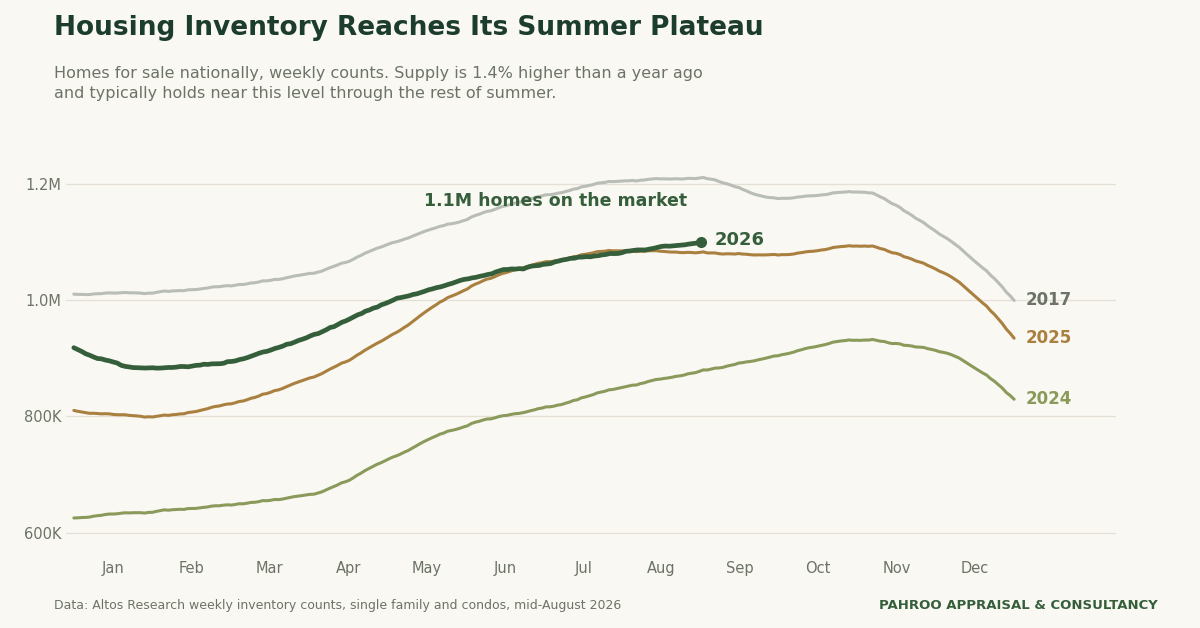
The weekly tracking comes from Altos Research, which counts every active listing in the country. The longer arc shows up in the Federal Reserve’s national active listing data as well: supply has been rebuilding for several years, but it is still climbing gradually, not flooding the market.
Compare this to September 2023, when rates jumped 70 basis points in a single month and demand fell hard. Rates have moved a similar amount this time, but over five months. So the squeeze is real, just slower and easier to miss.
Why Chicago Is Running Against the National Grain
National averages hide a lot. Markets with plenty of supply, including Las Vegas and Seattle, are seeing slightly negative price movement. Recovering metros such as San Francisco and Miami have flipped back to appreciation. Tight supply markets, and Chicago is the clearest example, are still posting gains.
Chicago never overbuilt during the pandemic run, and listing activity here has stayed thin relative to demand. When few homes come to market, even modest buyer interest keeps prices firm. That is why a homeowner in Portage Park or Evanston can still see values inching up while the national headline reads flat.
In practice, this split means national coverage tells you very little about your own block. A Chicago real estate appraisal works from local sales, local supply, and the specific condition of your property, which is where the real answer lives.
Price Reductions Are the Early Warning System
One national figure deserves special attention: 41.7 percent of homes on the market have taken a cut from their original list price. At the current pace, that share will pass last year’s level sometime in September.
Price reductions matter because they lead sale prices by roughly three to six months. Sellers adjust their asking price before closed sales show any weakness. So a rising reduction rate in August hints at softer closing prices heading into winter, even while the median holds steady today.
Still, a price cut is not a crash signal. Reduction rates ran at similar levels last fall, and national prices finished the year flat rather than down. The takeaway is direction, not disaster: sellers have less pricing power than the headline median suggests.
What a Flat Market Means for Your Home’s Appraised Value
A flat market is deceptively tricky for valuation. When prices rise or fall steadily, recent sales point clearly in one direction. When the market goes sideways with four in ten listings cutting price, the spread between asking prices and closed prices widens. Two similar homes on the same street can sell months apart at noticeably different numbers.
This is where automated estimates struggle. Algorithms lean heavily on list prices and older sales, and both are unreliable guides right now. An appraiser instead works from verified closed sales, adjusts for condition and timing, and weighs how long comparable homes actually sat before selling.
For homeowners, the flat national picture cuts both ways. If you are selling, pricing to the market on day one matters more than usual, because chasing the market down with reductions costs both time and money. The stakes rise further in an estate, a divorce, or a tax appeal. In those settings, a defensible number matters most exactly when public data sends mixed signals. Our residential appraisal services exist for exactly these moments.
Waiting for Lower Rates Carries Its Own Cost
Plenty of buyers are sitting out this fall, waiting for rates to drop. That is understandable, but the trade is rarely free. When rates fall, sidelined demand tends to return quickly, and competition comes back with it. More inventory and less competition almost never arrive at the same time.
Buyers shopping this fall face higher borrowing costs but more choices, more negotiating room, and sellers who have already trimmed their expectations. Buyers who wait may get a cheaper loan on a more expensive, more contested house. Neither path is wrong. But each one has a price tag, and it helps to see both clearly.
How to Read Your Own Market This Fall
Ignore the national median and watch three local signals instead. First, how many homes like yours are actually for sale within a mile or two. Second, what share of those listings have cut their price. Third, how long recent sales sat on the market before going under contract. Those three numbers reveal whether your neighborhood behaves like flat national America or like tight supply Chicago. Then, if a real decision rides on the answer, skip the algorithm. Get a professional opinion of value instead.
Your Block Is Not the National Average
Flat headlines, rising Chicago values, and four in ten listings cutting price. An independent appraisal cuts through the noise with a number built from your street, not the country’s.
Frequently Asked Questions
Is fall 2026 a buyer’s market?
Not fully, but it leans that way in many metros. Inventory is above 1.1 million homes and 41.7 percent of listings have cut their price, so buyers have more choices and more room to negotiate. Tight supply markets like Chicago remain closer to balanced.
Why are home prices flat when inventory is rising?
Inventory is rising slowly, about 1.4 percent year over year, while demand has cooled by a similar amount. Supply and demand are weakening together, so the national median price near $399,000 has stayed essentially unchanged from last year.
Are Chicago home prices still going up in 2026?
Yes. Chicago remains a tight supply market, and homes here are still posting modest gains even as the national median stays flat. Local supply, not the national headline, is what drives values on your block.
What does a 41.7 percent price reduction rate mean?
It means 41.7 percent of active listings have lowered their price from the original asking number. Price reductions lead closed sale prices by roughly three to six months, so a rising rate suggests softer prices ahead, though not necessarily declines.
Should I wait for mortgage rates to drop before buying?
Waiting can backfire. When rates fall, sidelined buyers return and competition rises with them. Today’s market offers more inventory and more negotiating room, so the choice is between a cheaper loan later or a better selection now.
Get a Number You Can Act On
Founded in Chicago and led by designated MAI and SRA appraisers, PahRoo Appraisal & Consultancy values residential and commercial property across Cook County, Dallas-Fort Worth, Philadelphia, Phoenix, and Naples. Whether you need a market value opinion before listing, an estate or divorce appraisal, or support for a tax appeal, our real estate appraisal services deliver independent, defensible answers you can build a decision on.