Category: Real Estate

Request a quote

Our blog

Latest news
& events

2026 Cook County reassessment notice used for property tax appeal appraisal
Commercial Refinancing Cliff 2026, What the Data Says

The commercial refinancing cliff turned out to be a slope. That is not the same as flat ground. Mortgage Bankers Association data puts $875 billion of commercial and multifamily debt maturing in 2026, down from $957 billion in 2025. Another $652 billion sits behind it in 2027. The peak has passed. What remains is a long stretch of loans written at rates that no longer exist, many already extended once. Every one of them arrives at a credit committee that will ask what the property is worth today.

By the end of this article, you’ll know:

  • What MBA’s 2026 maturity survey actually shows, by property type and by lender type
  • Where the equity gap comes from when a loan matures into a higher-rate, tighter-underwriting market
  • Why an appraisal ordered months ahead of maturity changes the conversation for both the lender and the borrower

What the Commercial Refinancing Cliff Looks Like in the Data

The Mortgage Bankers Association released its 2025 Commercial Real Estate Survey of Loan Maturity Volumes in February. Seventeen percent of the $5.0 trillion in outstanding commercial mortgages, or $875 billion, matures in 2026. That is a 9 percent decrease from 2025. MBA’s chief economist called 2025 a transition year. Lenders stopped simply extending loan terms, and the wall of scheduled maturities began to shrink.

The distribution matters more than the headline. Among property types, 30 percent of hotel loans come due this year. Industrial follows at 23 percent, then office at 17, health care at 15, and multifamily at 13. Among lender types, depositories carry $396 billion of the 2026 maturities. CMBS, CLO, and other securitized loans carry $200 billion. Credit companies and warehouse lenders carry $163 billion. Life insurers hold $76 billion. Agency and FHA multifamily paper, by contrast, has only $39 billion coming due.

So the refinancing question in 2026 is not spread evenly. It sits with banks and non-bank lenders, and with the property types that borrowed hardest in the low-rate years. MBA also notes that the figures are unpaid balances as of December 31, 2025. So the amounts at maturity will be somewhat lower. The direction is still the same.

Why a Maturing Loan Becomes an Equity Gap

A loan written in 2019 or 2021 was sized against a value, a rate, and an income stream. All three looked different from today. When it matures, the lender does not care what the property was worth then. The new loan is sized against current value, current net operating income, and current rates.

Three things compress at once. Higher rates mean the same NOI supports less debt, because coverage has to hold. Tighter underwriting means lower loan-to-value limits and more conservative vacancy and expense assumptions. And where value has fallen, the loan-to-value math starts from a smaller number. The gap between what the new loan will support and what the old loan still owes is the equity gap. Someone has to fill it: the borrower with cash, a partner with capital, or the lender with a restructure.

The loans that were extended in 2024 and 2025 are the ones most exposed now. An extension bought time; it did not change the rate the property has to refinance into. MBA expects the Federal Reserve to be near the end of its rate-cutting cycle. So the relief many borrowers were waiting for is largely already priced in. Our commercial appraisal work in 2026 has increasingly been on exactly these files.

What Credit Committees Are Asking For

The underwriting questions have not changed much. What has changed is how little tolerance there is for assumptions. Committees want sustainable NOI, not the peak year. They want vacancy assumptions that reflect the submarket, verified lease terms and rollover exposure, and normalized expenses that account for insurance and tax increases. Then an exit cap rate that would survive a skeptic.

A lender who orders the appraisal early gets those answers before the file is in front of the committee. A borrower who orders it early gets them before the lender does. That is the better position to negotiate from. Either way, the report replaces the argument. Instead of debating whether the 2021 value still holds, both sides work from a current opinion with the comparables and income analysis laid out.

This is also where property tax belongs in the conversation. A Cook County commercial assessment that runs above market value inflates the expense line. That drags NOI and shrinks the loan the property can support. An appraisal prepared for the refinance often becomes the evidence for an appeal, so the two efforts pay for each other.

Not Every Property Type Faces the Same Cliff

The maturity shares tell you where the pressure concentrates. Hotels carry the largest share of 2026 maturities by property type. Hotel income is also the most sensitive to travel demand and operating cost. Industrial has the second largest share. After years of strong rent growth, underwriting has become more careful about whether that growth continues in a given corridor.

Office is the type everyone expects to see on this list, and 17 percent of office loans do mature this year. The variation between buildings is wide. A leased suburban building and a half-empty tower downtown are both office. They will not appraise or refinance the same way. Multifamily has the smallest share maturing among the major types. Much of that is agency paper with ready refinancing options.

The lesson for a lender or an owner is that the headline number tells you very little about your loan. The property’s own income, its lease roll, its submarket, and its condition decide the outcome. That is what an appraisal is for. It is also why a generic model does not settle a credit committee.

If Your Loan Matures in the Next 18 Months

If you own the property, or advise the owner, start earlier than feels necessary. Ninety days before maturity is too late to source new capital, restructure with a partner, or bring in a second lender. Six to nine months out is when an appraisal gives you room to act on what it says.

Bring the appraiser the full picture. That means the rent roll, twelve months of operating statements, the current tax bill and any pending appeal, capital spending since the last appraisal, and the existing loan terms. An appraisal is only as good as the income it can verify. Then take the report to the lender before the lender’s own appraiser has been ordered. Walking in with a supported number and a plan for any gap is a different meeting than walking in with a hope.

A Slope Rewards the Prepared

The refinancing wave did not break all at once, and MBA’s data says the worst of it is behind the market. What is left is steadier and longer: $875 billion this year and $652 billion next year, much of it already extended. Most of it sits with the banks and private lenders who have the least room to pretend the 2021 value still stands.

For a lender, the early appraisal is how a maturing loan becomes a workable refinance instead of a workout. For an owner, it is how an equity gap becomes a known number with a plan attached, not a surprise at the closing table. Either way, the number has to be current, supported, and written so a credit committee can test it.

Maturing in 2026 or 2027? Know the Number First.

PahRoo prepares commercial appraisals for refinancing, restructuring, and credit review across Chicago and the collar counties, with the income analysis and comparable sales laid out for committee scrutiny. Michael Hobbs, MAI, SRA, signs every report.

Request a Commercial Appraisal

Frequently Asked Questions

How much commercial debt matures in 2026?

According to the Mortgage Bankers Association’s 2025 Commercial Real Estate Survey of Loan Maturity Volumes, $875 billion, or 17 percent of the $5.0 trillion outstanding, is scheduled to mature in 2026. That is 9 percent less than the $957 billion scheduled for 2025, with $652 billion scheduled for 2027.

Is the commercial refinancing cliff over?

MBA’s data suggests the peak of the maturity wave has passed, but the volume remains elevated and many 2026 maturities are loans that were already extended once. The pressure has shifted from size to duration.

What is an equity gap in a commercial refinance?

The difference between the balance owed on the maturing loan and the amount a new loan will support at current value, current income, and current rates. The borrower, a capital partner, or a restructure has to cover it.

Which property types have the most loans maturing in 2026?

By share of outstanding balance, hotel loans lead at 30 percent, followed by industrial at 23 percent, office and health care at 17 and 15 percent, and multifamily at 13 percent, per MBA.

When should an owner order an appraisal before maturity?

Six to nine months out. That leaves time to act on the result: source capital, negotiate a restructure, pursue a tax appeal, or approach a second lender. Ninety days before maturity is usually too late.

Commercial Appraisals Built for Credit Review

PahRoo appraises office, industrial, retail, multifamily, and mixed-use property for lenders and owners across Chicago and Cook County. Our commercial appraisal reports are written for refinancing, restructuring, and litigation, with the income approach shown in full. The same team handles Cook County property tax appeal appraisals, which often start from the same refinance file.


2026 Commercial Refinancing Cliff showing CRE loan maturities
The 2026 Commercial Refinancing Cliff

The 2026 Commercial Refinancing Cliff is no longer theoretical. It is here.

More than $1.5 trillion in commercial real estate loans are scheduled to mature between now and the end of 2026. Many of those loans were originated in a low-interest-rate environment that no longer exists. What was once inexpensive leverage is now a refinancing challenge.

However, this is not just about higher rates.

It is about tighter underwriting, valuation recalibration, and a new level of scrutiny from lenders. In this environment, a professional commercial appraisal is not a checkbox. It is leverage.

For attorneys, bankers, accountants, and commercial property owners, the question is simple:

What is the property defensibly worth today, not in 2022?

The Reality Behind the $1.5 Trillion Maturity Wave

According to the Mortgage Bankers Association (MBA), more than $1.5 trillion in commercial mortgage debt is scheduled to mature through 2026. Federal Reserve rate policy shifts and capital market tightening have further complicated refinancing assumptions. Data from Trepp’s CRE research reports also shows increased delinquency pressure across certain asset classes, reinforcing why accurate underwriting inputs matter more than ever.

As a result, many properties now face a triple pressure point:

1. Higher Borrowing Costs

Interest rates remain materially above the levels of five to ten years ago. Even stabilized assets may struggle to meet prior debt service metrics.

2. Stricter Underwriting Standards

Debt Service Coverage Ratio (DSCR) thresholds are tighter.
Loan-to-Value (LTV) limits have compressed.
Credit committees are scrutinizing assumptions with far more conservatism.

3. Valuation Volatility

Office usage has shifted. Retail absorption varies by submarket. Insurance costs and operating expenses have risen across multifamily and hospitality. Industrial demand has cooled in certain corridors.

Because of these factors, refinance proceeds may not match the maturing loan balance. That difference is the equity gap.

The 2026 Commercial Refinancing Cliff is not just about rates. It is about value recalibration.

Why the 2026 Commercial Refinancing Cliff Creates Equity Gaps

When a loan matures, the lender evaluates current market value, not historic purchase price or past optimism.

If valuation declines — even modestly — leverage compresses.

For example:

      • A property financed at 75% LTV five years ago may now qualify for only 60–65%.
      • NOI adjustments from higher expenses reduce supportable loan proceeds.
      • Lease rollover risk may materially impact underwriting assumptions.

Without a clear, defensible appraisal, negotiations become reactive instead of strategic.

You do not want to discover the equity gap at the closing table.

You want clarity months in advance.

How a Professional Appraisal Protects Your Refinance

A credible commercial appraisal provides more than a number. It provides positioning.

1. You Gain Realistic Market Intelligence

In a K-shaped recovery, some assets are outperforming while others struggle. A data-driven appraisal clarifies where your property sits within its competitive set.

This is not about optimism.
It is about defensibility.

With credible market analysis, you walk into lender conversations prepared — not guessing.

2. You Reduce Credit Committee Friction

Bankers are under pressure. Regulators are watching. Risk tolerance has narrowed.

A well-supported appraisal:

      • Documents income stability
      • Addresses lease rollover exposure
      • Explains market absorption trends
      • Clarifies capitalization rate positioning

When documentation is thorough, lender objections decrease.

Instead of debating assumptions, the conversation shifts to structure.

That shift matters.

3. You Strengthen Negotiation Leverage

If refinancing falls short, you may need:

      • Additional equity
      • Loan restructuring
      • Capital partner discussions
      • Workout negotiations

An accurate appraisal becomes the anchor for every one of those conversations.

Attorneys negotiating restructuring need defensible value.
Accountants advising clients need realistic asset positioning.
Owners evaluating capital calls need clarity before making commitments.

The 2026 Commercial Refinancing Cliff rewards preparation. It penalizes delay.

What Credit Committees Are Looking for in 2026

Understanding lender psychology improves outcomes.

In 2026, credit committees are prioritizing:

      • Sustainable NOI (not peak-year income)
      • Conservative vacancy assumptions
      • Verified lease terms
      • Expense normalization
      • Realistic exit capitalization rates

Credit committees are stress-testing projections and comparing submarket trends with increased scrutiny. Tenant credit quality is also under deeper review than in prior cycles.

A professional appraisal anticipates those questions before they are asked.

That preparation reduces uncertainty and uncertainty is what stalls approvals.

Asset Class Sensitivity Matters

Not all properties face the refinancing cliff equally.

Office:
Tenant downsizing and hybrid models continue to pressure absorption in many CBD submarkets.

Multifamily:
Higher insurance premiums and operating costs impact net income, particularly in Sunbelt regions.

Retail:
Service-oriented and grocery-anchored centers are outperforming discretionary retail.

Industrial:
Cooling demand in certain logistics corridors has moderated rent growth assumptions.

An appraisal grounded in real-time submarket data distinguishes resilient assets from vulnerable ones.

Generic modeling does not.

The Risk of Waiting

One of the most common mistakes owners make is waiting until 30–60 days before loan maturity to obtain an appraisal.

By then:

      • Negotiating leverage is reduced
      • Alternative lenders may require expedited underwriting
      • Equity partners have limited time for review

Early appraisal provides optionality.

Optionality means:

      • Time to source new capital
      • Time to restructure intelligently
      • Time to adjust strategy

The 2026 Commercial Refinancing Cliff is steep. But it is manageable for those who prepare early.

Why This Matters to You

If you are advising clients — or protecting your own portfolio — uncertainty is the real risk.

A defensible commercial appraisal gives you:

      • Clarity before negotiations begin
      • Credibility in front of lenders
      • Data to support restructuring discussions
      • Strategic positioning instead of reactive decision-making

In this lending environment, numbers unsupported by rigorous analysis will not survive credit review.

Professional documentation will.

Prepare Before the Maturity Date

The refinancing wave is not slowing. It is accelerating toward 2026.

The question is not whether underwriting has tightened.
It has.

The question is whether you enter the refinance discussion prepared.

The 2026 Commercial Refinancing Cliff separates speculative assumptions from defensible analysis.

An early, well-supported commercial appraisal provides the clarity you need to protect equity, strengthen negotiations, and move forward with confidence.

Certified USPAP appraisal report for Chicago probate estate settlement. Hand protecting a property
Chicago Probate Appraisal: A Legal Safeguard in 2026

A Chicago probate appraisal is no longer a formality. In early 2026, it has become a legal safeguard for executors, trustees, and the attorneys advising them. According to recent Chicago metro data, inventory is rising modestly, demand is uneven, and nearly three in ten listings have experienced price reductions, signaling buyer resistance and increased scrutiny on pricing assumptions.

Consequently, estates relying on outdated or surface-level appraisals expose themselves to audit risk, beneficiary disputes, and IRS challenges tied directly to Step-up in Basis reporting. The American Bar Association outlines these fiduciary responsibilities clearly in its Guidelines for Individual Executors and Trustees.

What the Chicago Market Is Signaling to Fiduciaries

Specifically, the Chicago-Joliet-Naperville MSA is transitioning from an ultra-tight sellers’ market into a more balanced phase. New listings surged week-over-week, while pending sales softened and days on market extended to a median of 77 days for both single-family homes and condos.

Furthermore, mortgage rates have declined nearly a full percentage point year-over-year, yet buyers remain selective. This disconnect means price stability on paper does not equal defensible fair market conclusions inside a certified probate report.

The insights shared here are based on a detailed Chicago market report prepared for probate and fiduciary use, and the full report is available for those who want to explore the data in more depth, you can check the report here.

Probate Appraisals Are About Defense, Not Optimism

For probate matters, optimism is irrelevant. Accuracy is the defense.

USPAP-compliant probate appraisals must reconcile:

    • Seasonality distortions common in January closings
    • Active price reductions that are not yet reflected in closed sales
    • Micro-market differences between Chicago neighborhoods and nearby suburbs

Therefore, a certified report prepared without real-time market awareness can misstate basis, complicate tax filings, and invite unnecessary scrutiny from the IRS or opposing counsel.

How PahRoo Supports Chicago Probate Matters

PahRoo prepares Chicago probate appraisals with attorneys and fiduciaries in mind. We analyze single-family and condominium trends separately, apply USPAP standards rigorously, and document every assumption with audit clarity. As a result, executors gain peace of mind, and advisors protect both the estate and their own professional exposure.

Schedule a Consultation

Estate planning and probate appraisal for commercial real estate valuation
From Comps to Code in Today’s Commercial Appraisals

For decades, commercial real estate appraisal relied on a familiar foundation: comparable sales, income analysis, and professional judgment informed by local market knowledge. That framework still matters, but it’s no longer the full story.

Across jurisdictions like Cook County, assessment offices are moving away from purely comp-driven reasoning and toward valuation systems built on large datasets, statistical modeling, and automated analysis. The shift is subtle, but its impact is significant.

In today’s environment, commercial appraisals are increasingly evaluated not just on what value they conclude, but on how that value was produced.

Why “Comps” Alone Are Losing Influence

Comparable sales have long been the backbone of commercial property appraisal. They remain essential, but assessors now view them as just one input among many.

Offices such as the Cook County Assessor’s Office are increasingly integrating broader datasets, including federal appraisal and housing data from the Federal Housing Finance Agency (FHFA).

These datasets support:

      • Regression-based valuation models
      • Automated valuation models (AVMs)
      • Market-wide consistency testing
      • Equity and regressivity analysis

When assessments are defended using these tools, appeals based solely on narrative adjustments or limited comps can struggle to gain traction.

What “Code” Really Means in Modern Appraisal

“Code” doesn’t replace appraisal judgment, but it does change how that judgment is scrutinized.

Modern commercial appraisals are increasingly assessed against:

      • Data relevance and scale
      • Transparency of methodology
      • Replicability of conclusions
      • Consistency across property classes

For professionals involved in commercial real estate appraisal for tax appeals, this means valuation credibility now hinges on explaining methodology as clearly as market behavior.

In other words, the appraiser’s role has expanded from market interpreter to valuation explainer.

The New Battleground in Property Tax Appeals

In a data-driven assessment environment, appeals are less about debating opinion and more about evaluating process.

Effective challenges increasingly focus on:

      • Whether model inputs accurately reflect the subject property
      • Whether income assumptions align with real operating realities
      • Whether classification or use errors skew the data
      • Whether equity claims hold up at the property level

This shift doesn’t eliminate comps, it reframes them. Comparable sales now support or challenge model assumptions rather than serving as the sole basis for value.

Why This Shift Extends Beyond Tax Appeals

The move from comps to code isn’t limited to assessment disputes. The same expectations are influencing appraisals used in legal and advisory contexts.

Attorneys working in:

      • Estate planning appraisal
      • Probate real estate appraisal
      • Date-of-death property appraisal
      • Litigation support appraisal

are increasingly focused on whether an appraisal can withstand scrutiny, not just whether it reaches a reasonable number.

For probate attorneys, especially those handling income-producing or mixed-use commercial properties, valuation clarity and defensibility are essential.

Commercial Appraisals in Probate and Estate Planning

Commercial properties involved in estates present layered appraisal challenges: income history, tenancy changes, market conditions at a specific date, and regulatory expectations.

A credible probate appraisal for real estate must:

      • Address the correct valuation date
      • Clearly document data sources and assumptions
      • Explain methodology in plain, defensible terms
      • Align with IRS, court, and professional standards

As data-driven appraisal becomes more common, courts and counsel are less tolerant of appraisals that rely on surface-level analysis without methodological support.

What Attorneys Should Expect from Modern Appraisals

For tax attorneys, probate attorneys, and real estate counsel, today’s commercial appraisals should provide more than a conclusion—they should provide insight.

Key expectations now include:

      • Transparent explanation of valuation methods
      • Clear articulation of data limitations
      • Logical reconciliation of comps and models
      • Defensible reasoning under cross-examination

This is especially critical in expert witness appraisal services, where the ability to explain both market behavior and data-driven analysis can determine credibility.

Why the Shift Will Continue

Assessment offices face increasing pressure to demonstrate fairness, consistency, and accountability. Large datasets and automated models help meet those expectations.

As these tools become standard, commercial appraisals that fail to engage with methodology, not just market value—will feel outdated.

For firms like PahRoo, this evolution reinforces the value of disciplined, well-documented commercial appraisal work across tax appeals, estate planning, and probate matters.

Commercial appraisal hasn’t abandoned comps, but it has moved beyond them.

In today’s environment, the most credible valuations are those that connect market evidence with data-driven reasoning and clearly explain how conclusions are reached.

For property owners, attorneys, and fiduciaries navigating tax appeals or estate-related matters, working with appraisers who understand both sides of that equation—comps and code—is no longer optional. It’s the standard.

Let’s Talk Before the Numbers Are Challenged for You

If your assessment, appeal, or estate valuation is being defended with data models instead of comps, it’s worth a conversation.
Speak with our commercial appraisal team to understand how today’s valuation methods affect your case and how to respond with confidence.


Schedule a Strategy Call

Commercial real estate appraisal in Chicago during the 2025 North Cook reassessment
Chicago Commercial Appraisals: Do These Values Hold Up?

Commercial Real Estate Appraisal Chicago: What the 2025 North Cook Reassessment Is Telling Property Owners

As the 2025 North Cook reassessment cycle comes into focus, many commercial property owners are asking the same question:

Do these values really reflect today’s market?

Early results suggest that in several submarkets, assessed values increased even while fundamentals, occupancy, effective rents, and demand, remain under pressure. For anyone navigating a commercial real estate appraisal in Chicago, these patterns matter more than ever.

Assessment Increases That Don’t Match Market Conditions

Across parts of North Cook County, we’re seeing commercial assessments rise in ways that appear disconnected from on-the-ground realities.

Retail corridors in Evanston and Skokie experienced notable increases despite:

    • Persistent vacancy
    • Slower leasing velocity
    • Pressure on tenant sales and rent growth

Office properties tell a similar story. In several areas, valuations ticked upward even as hybrid work, sublease inventory, and reduced effective income continue to weigh on performance.

If your assessment doesn’t reflect how your property actually performs, you may be carrying an unnecessary tax burden.

A Familiar Pattern for Chicago-Area Property Owners

For owners who went through the 2024 reassessment cycle in Chicago, these trends may feel familiar.

That cycle was marked by:

    • Aggressive income modeling
    • Uneven adjustments between submarkets
    • Valuations that required deeper analysis to reconcile with reality

The 2025 North Cook outcomes suggest a similar approach, one where assumptions matter just as much as numbers. That makes a well-supported commercial real estate appraisal in Chicago an essential tool, not a formality.

Why This Matters Beyond North Cook

Commercial real estate appraisal in Downtown Chicago during the 2025

These reassessment results don’t just affect current tax bills, they offer insight into what may come next.

Patterns emerging in North Cook often influence future methodology, including how the Assessor approaches South Cook reassessment cycles. Understanding how values are being modeled now can help owners prepare earlier, appeal smarter, and avoid surprises later.

Early insight gives you leverage, before deadlines compress and options narrow.

When a Commercial Real Estate Appraisal Becomes Strategic

In reassessment years like this, an appraisal isn’t just about value, it’s about clarity.

A defensible, market-supported appraisal can:

    • Identify mismatches between assessed value and real income
    • Test the assumptions embedded in mass appraisal models
    • Support appeals with data grounded in current market conditions

For Chicago-area owners, this is where commercial real estate appraisal expertise becomes a strategic advantage rather than a compliance exercise.

Capacity for Select New Engagements in 2025

The quieter holiday season was used to streamline internal processes, expand the team, and create capacity for a limited number of new clients in 2025.

For owners facing assessments that don’t align with performance or those planning ahead for upcoming cycles, now is often the right time to evaluate options before appeal windows close.

When valuation models and market reality diverge, who’s pressure-testing the numbers on your behalf?

Cityscape Overview With Office Buildings And Residential Homes Background
What 2026 Fed Rate Cuts Mean for CRE

Commercial real estate investors, owners, and lenders are paying close attention to interest rate expectations as 2026 comes into view. There’s growing talk about possible Federal Reserve rate cuts, but for CRE, the real issue isn’t simply whether rates go down. It’s whether those cuts will actually make financing meaningfully easier.

That distinction matters. As a recent analysis from Realtor.com points out, lower Fed rates don’t automatically translate into cheaper commercial loans. Even if the Fed eases policy in 2026, mortgage rates, especially on the commercial side, may stay higher than many borrowers expect.

For anyone buying, refinancing, or planning an exit, understanding how Fed decisions actually filter through capital markets can make the difference between a smart move and an expensive misstep.

The 2026 Fed Rate Cut Outlook

Right now, markets are betting on one or two rate cuts in 2026, largely based on expectations that inflation continues to cool and economic growth slows. Those expectations show up in futures markets and investor positioning, but they aren’t guarantees.

It’s also worth remembering that the Fed sets short-term rates. Most commercial real estate loans, especially fixed-rate debt, are priced off longer-term benchmarks. That gap between policy and pricing is where a lot of confusion comes from.

Why Fed Rate Cuts Don’t Automatically Lower CRE Loan Rates

One of the most common misunderstandings in commercial real estate is assuming that Fed cuts lead directly to cheaper loans. In practice, CRE borrowing costs are influenced by several other factors, including:

  • 10-year Treasury yields, which anchor many fixed-rate loans
  • Credit spreads, which widen or tighten based on perceived risk
  • Lender balance sheets and risk tolerance
  • Property-level fundamentals, like occupancy, cash flow, and lease rollover

Even if the Fed cuts rates, lenders may keep spreads wide if uncertainty remains, especially for properties that are transitional, underperforming, or tied to weaker sectors.

Commercial Real Estate Sectors Most Impacted

Office Properties

Office continues to face the most pressure. Higher vacancies, shorter leases, and refinancing risk mean that rate cuts alone aren’t likely to reset values. Lenders are expected to stay cautious, with tighter underwriting and lower loan-to-value ratios.

Multifamily

Multifamily may see more direct benefits from improving rate conditions, particularly for stabilized assets in supply-constrained markets. That said, new deliveries in some areas could limit how much relief lower rates actually provide.

Retail and Industrial

Retail and industrial properties with strong tenants and long-term leases are generally in the best position. For these assets, any improvement from rate cuts is more likely to show up gradually, rather than through a sudden drop in cap rates.

What This Means for CRE Appraisal in 2026

Rates matter, but they’re only part of the picture. In 2026, values will still hinge on fundamentals such as:

  • Stability of net operating income
  • Lease rollover exposure
  • Asset quality and location
  • Lender appetite and available capital

Lower benchmark rates may take some pressure off, but properties with weak fundamentals will continue to face valuation challenges.

Strategic Considerations for CRE Owners and Investors

Why this matters: understanding the gap between Fed policy and real-world lending can help you avoid poor timing decisions.

  • Don’t assume refinancing gets easier just because rates are “supposed” to fall
  • Start planning early for loan maturities in 2026–2027
  • Run conservative scenarios when underwriting or refinancing
  • Use credible, well-supported appraisals when talking to lenders

In this cycle, preparation tends to matter more than predictions.

The outlook for 2026 points to measured optimism, not a rate-driven turnaround. Even if the Fed begins cutting rates, commercial real estate financing will remain selective and highly asset-specific.

For CRE owners and investors, success will depend less on headlines and more on fundamentals, realistic valuations, and proactive planning.

If you’re thinking about refinancing, selling, or approaching a loan maturity, understanding your property’s current market value is critical, especially in a shifting rate environment.

Get clarity before conditions change.

Commercial property tax appeal strategy showing how rising levies impact tax bills
Why Commercial Property Tax Bills Still Rise

Winning the Appeal Isn’t the Finish Line: Why Commercial Property Tax Bills Still Rise

For experienced property tax attorneys, a successful appeal has traditionally meant a clear outcome: lower assessed value, lower tax bill.

Increasingly, that relationship no longer holds.

Across major U.S. markets including Chicago, Philadelphia, Dallas, Naples, and Phoenix, attorneys are encountering a growing disconnect between assessment victories and actual tax relief. Clients win the appeal, yet the tax bill still increases.

This isn’t a valuation failure.
It’s a levy-driven reality that’s reshaping how effective counsel must advise commercial property owners.

The Structural Issue Attorneys Are Now Forced to Address

In levy-driven tax systems, taxing bodies determine revenue needs first. Tax rates then adjust to meet those levies, regardless of how individual assessments move. Cook County Treasurer – Property Tax System Primer, explains levy-driven systems, how levies are set, and how rates are derived across taxing districts.

Our review of 275 commercial property tax bills post-appeal showed:

  • 38% increased year over year
  • Even when assessed values were reduced by more than 15%

The culprit wasn’t weak advocacy.
It was rising levies from school districts, municipalities, and pension-obligated entities that quietly outpaced assessment reductions.

For attorneys, this creates a professional risk:

Winning the case, but losing client confidence.

How This Plays Out by Market (Attorney Perspective)

While the mechanics are universal, each market applies pressure differently and sophisticated counsel now accounts for that nuance. These dynamics are documented across property tax systems nationwide, where local governments levy property taxes as a major source of local revenue.

Chicago (Cook County) 

Aggressive levy growth, overlapping taxing districts, pension funding obligations, and frequent TIF reallocations make Cook County the most visible example. Appeals focused solely on value often fail to anticipate rate compression. Check Cook County Assessor System Overview — for local system nuance in Chicago

Philadelphia

School district funding demands and shifting assessment practices can neutralize appeal gains, particularly when levy increases coincide with reassessment cycles.

Dallas

Rapid municipal growth, infrastructure expansion, and school funding needs create levy pressure that can dilute even substantial assessment reductions.

Naples (Collier County)

Special districts, redevelopment initiatives, and targeted funding measures can quietly shift tax burdens, especially in high-value commercial corridors.

Phoenix (Maricopa County)

Voter-approved funding measures and expanding tax bases redistribute liability, requiring appeal strategies to be evaluated alongside revenue modeling.

The common thread: 
Assessment appeals are necessary, but no longer sufficient on their own.


How Leading Attorneys Are Reframing Their Advisory Role

The most effective attorneys are adapting by expanding the scope of counsel, not abandoning appeals.

They are:

    • Using district-specific levy forecasts to set expectations before filing
    • Engaging earlier in budget hearings and abatement discussions
    • Coordinating with commercial property appraisal teams to identify when appeals are technically winnable but strategically ineffective

In one downtown case, a law firm helped a client avoid a six-figure exposure by pairing its appeal strategy with a levy-impact model that flagged a mid-cycle rate increase tied to a local referendum, before it surfaced on the tax bill.

That outcome didn’t come from litigation skill alone. It came from anticipating the revenue side of the equation.

Why This Matters for Attorney-Client Relationships

Clients are no longer satisfied with reactive explanations after the bill arrives.

They expect counsel to:

  • Explain why outcomes differ from expectations
  • Flag risks before decisions are locked in
  • Provide context beyond the assessment notice

Attorneys who incorporate levy awareness into their advisory process are:

  • Better positioned to manage expectations
  • Less exposed to second-guessing
  • More likely to be viewed as strategic partners, not procedural advocates
A More Defensible Way to Advise on Commercial Property Tax

As levy-driven pressure intensifies, the attorneys who stand out will be those who prepare clients for both sides of the tax equation:

    • Assessment
    • Revenue demand

That dual-lens approach is quickly becoming the difference between “we won the appeal” and “we protected the client.”

Clients don’t expect certainty, but they do expect clarity. Attorneys who can explain why a successful appeal doesn’t always translate into tax relief will continue to set themselves apart.

Support Your Commercial Property Tax Appeal Strategy with Levy Intelligence

If you represent commercial property owners in Chicago, Philadelphia, Dallas, Naples, or Phoenix, winning the appeal is only part of the equation. In levy-driven tax environments, assessment reductions alone don’t always translate into lower tax bills.

Request a Levy Impact Analysis to:

    • Identify where commercial property tax appeal wins may be offset by rising levies
    • Strengthen client communication and expectation-setting before filing
    • Align valuation and appeal strategy with real-world tax outcomes across local taxing districts

Equip your clients with clarity and your practice with a defensible, data-driven advisory edge.


Chicago multifamily apartment building representing Class 3 commercial real estate properties affected by the 2024 assessments.
2025 CRE Class 3 Tax Planning After Assessment Increases

Cook County’s 2024 reassessment cycle brought major changes that will shape Class 3 tax planning for 2025, especially after the 34 percent rise in assessments. Class 3 multifamily buildings saw a 34% increase in assessed value, the largest rise among major property types. Many owners expected some level of appreciation, but the scale of these increases and the assumptions behind them are now shaping how investors and advisors’ approach 2025 tax planning. 

Where the Increases Hit the Hardest 

Several areas saw far stronger assessment pressure than others.
In the West Loop and Logan Square, assessments rose between 39 and 41 percent. These neighborhoods experienced a surge in rent after the pandemic. While income increased, some assessment models appear to have relied on cap rates that do not reflect actual market stability.
Bronzeville saw a 33 percent jump. New developments in the area created higher comparable values that influenced the assessments of older multifamily buildings, even when those buildings did not share the same finishes, amenities, or program incentives.
Across the Northwest Side, many assessments appear to be based on full occupancy and consistent market rent even when the rent rolls show a very different picture. Concessions, turnover, lease-up periods and renovation-related downtime all affect NOI, yet they were not always accounted for. 

These discrepancies matter because they shape the foundation of your 2025 tax planning. If the assumptions are flawed, the tax burden will be too. 

When the Assessment Does Not Reflect the Property’s Actual Performance 

Several tax attorneys report running into a familiar challenge at the Board of Review. Even when rent rolls show concessions or vacancies, the valuation model may still be built on stabilized income. In some cases, the assessment reflects an ideal version of the property rather than its real operating performance. 

This issue is not unique to Cook County. National research, including work from the Lincoln Institute of Land Policy, has called attention to how optimistic income assumptions can inflate multifamily property values. This makes accurate documentation essential during appeals. 

What Has Worked in Appeals This Year 

Many owners have seen better results when their appeals include valuation models tied directly to the building’s performance. This often starts with market adjusted NOI, block-level rent analysis, occupancy trends, and expense data that reflect the condition and age of the property. 

Once these real figures replace the assessor’s original assumptions, the valuation often shifts toward a more accurate reflection of the property’s current financial picture. This approach has been especially important for buildings where turnover, concessions, or renovation schedules create inconsistent income. 

Affordable Housing and the Importance of Early Planning 

Owners of Class 9 and LIHTC properties saw more successful outcomes when they planned both incentive strategy and appeal strategy together. When these processes are handled separately, key information may not be included, and opportunities for appraisal adjustments may be missed. 

For 2025 planning, aligning these strategies early helps avoid unnecessary risk. 

What Commercial Real Estate Owners Can Prepare for 2025 

Now is the time to review how each building has been valued and whether those assumptions match reality.
Owners should check whether the assessor’s income, occupancy and cap rate assumptions line up with the rent rolls.
Document anything that affects actual NOI, including turnover, concessions, vacancy, seasonal leasing patterns and any downtime caused by renovations.
If the property participates in a tax incentive program, review whether an integrated appeal and incentive plan would help protect the property from overvaluation.
Finally, compare your building’s performance to surrounding properties to identify where submarket trends support an appraisal adjustment. 

A 34% increase is a concern, but the bigger issue is whether your valuation reflects your building or a hypothetical version of it. Correcting these assumptions now can protect operating cash flow and support smarter tax planning for 2025. 

Every multifamily asset has its own income story, and effective Class 3 tax planning should reflect that reality. If you want support reviewing how the new assessments affect your properties or need guidance building a stronger strategy for 2025, we can help.

Contact us and let our team support your commercial real estate tax planning for the year ahead. 

Chicago mixed-use three-flat with commercial space showcasing residential and commercial market trends for November 2025.
Chicago Real Estate Market Update: What Week 47 Data Means for Buyers & Sellers

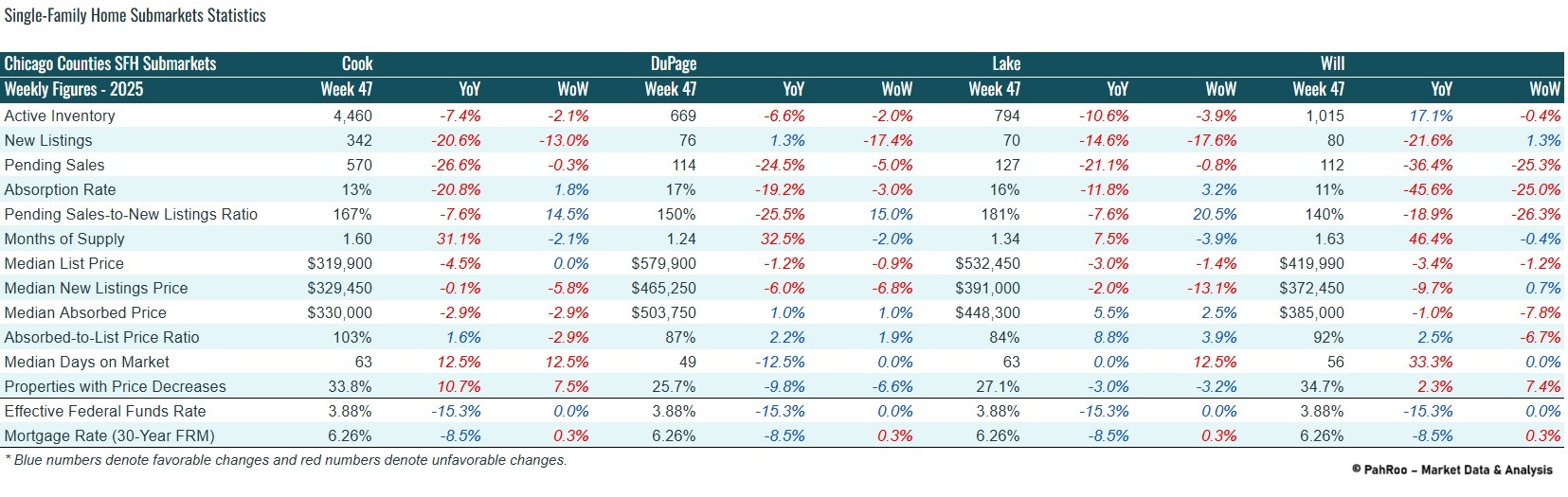
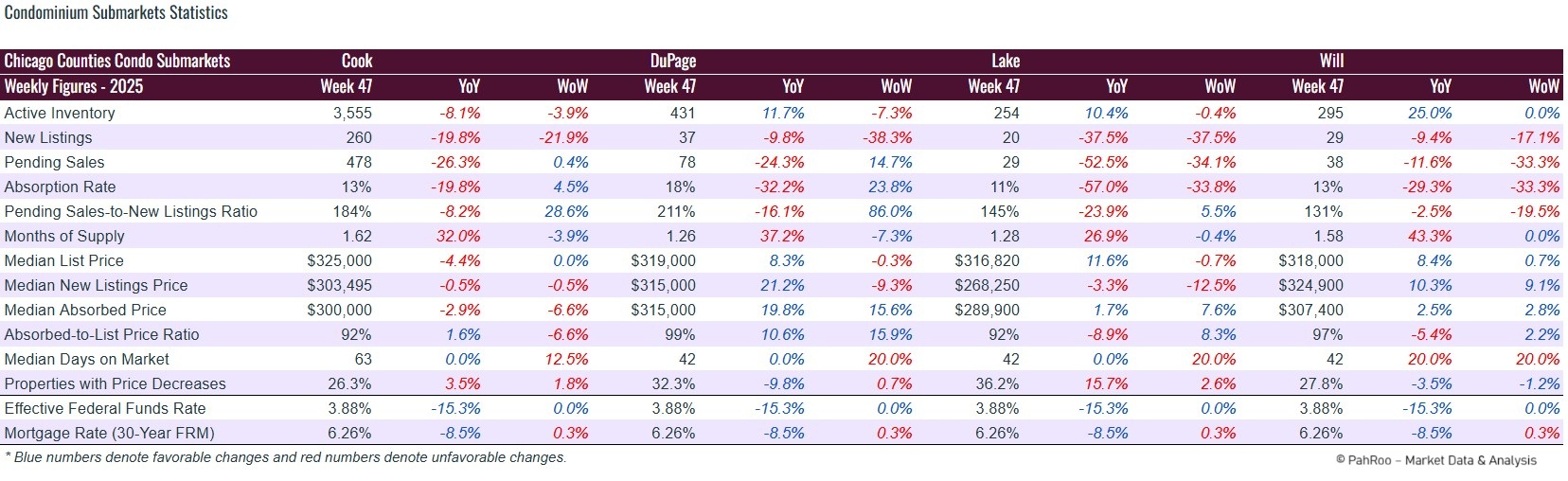
The Chicago real estate market continues to cool as we approach the end of 2025, and the latest weekly data shows a clear shift in both buyer and seller behavior. For the week ending November 21, 2025, new listings dropped sharply, pending sales continued their decline, and days on market rose across many Chicago counties. Whether you’re planning to buy, sell, or invest, understanding these trends can help you make smarter decisions.  

 This week’s update covers Cook, DuPage, Lake, and Will Counties, summarizing what changed, why it matters, and how you can use the data to your advantage.

Chicago real estate market trends for Week 47 of 2025 showing declines in new listings and pending sales.

Inventory Tightens as New Listings Decline 

Across most Chicago-area counties, the number of homes for sale continues to shrink.
According to the data in the report: 

  • Single-family new listings dropped as much as 20.6% in Cook and 21.6% in Will County.
  • Condo listings declined by nearly 20% in Cook and 37% in Lake County.
  • Active inventory fell in Cook, DuPage, and Lake for single-family homes.

The only exception is Will County, which showed a 17.1% increase in active single-family inventory, a sign of local shifts or catch-ups from earlier shortages. 

What's In It For You

If you’re a seller in Cook, Lake, or DuPage County, you’re competing with fewer listings, giving your home more visibility. Buyers, however, may find fewer options and more competition in certain neighborhoods. 

Sellers can benefit from a professional appraisal to understand how current pricing trends impact their latest market value.

Pending Sales Drop as Buyers Hesitate 

Demand softened significantly: 

  • Single-family pending sales fell 20–36% year-over-year.
  • Condo pending sales dropped as much as 52% in some submarkets. 

Buyer hesitation reflects persistent affordability concerns and cautious sentiment due to mortgage rates and economic uncertainty. 

What's In It For You
  1. If you’re a buyer, slower sales mean negotiation power.
  2. If you’re a seller, expect longer timelines and be strategic with pricing. 

Data Cook, DuPage, Lake, and Will counties used in Chicago housing market analysis for 2025.

Mortgage & Federal Reserve Impact 
  • 30-year fixed mortgage rate: 6.26% (down 8.5% YoY)
  • Effective federal funds rate: 3.88%

While rates are lower than last year, they remain high enough to cool buyer activity. This aligns with the slower transaction volume and longer days on market. Current rate trends can be tracked through the Freddie Mac PMMS and Federal Reserve rate updates.

Pricing Trends: Softening but Strategic 

Price behavior is mixed: 

  • Single-family median list prices fell 1–4.5% across all counties.
  • Condos saw more price stability, with DuPage and Lake showing YoY gains in median list and absorbed prices.

Many submarkets also had higher percentages of price reductions, indicating active price negotiations.

What's In It For You
  1. Buyers may find more room to negotiate.
  2. Sellers should price competitively from the start to avoid unnecessary reductions. 
Homes Take Longer to Sell 

Days on market is a clear indicator of market speed: 

  • Single-family DOM increased by 12–33% in Cook, Lake, and Will.
  • Condos showed similar patterns, with many counties seeing 20% increases.

As shown in the Market Health tables, the slower pace reflects cautious buyers and the need for competitive pricing. 

Actionable Insights for Today’s Market 
  • Buyers → More negotiation power, slower pace, better value opportunities. 
  • Sellers → Less competition in some counties but must price strategically. 
  • Investors → A cooling market may present buying opportunities, especially where inventory is rising (e.g., Will County). 
The Market Wrap-Up 

The Week 47 Chicago real estate update reveals a market adjusting to interest rates, shifting consumer confidence, and evolving supply-and-demand dynamics. Well-priced, move-in–ready homes continue to attract attention, but buyers are taking their time, making data-driven strategies essential for both sides of the transaction. 

To understand how these trends affect your plans, request an appraisal or get your home’s valuation to see your standing in the current market.


NEWSLETTER

Knowing a property's true value is key
to making informed real estate decisions

Visit us

7383 Lincoln Ave Suite,
#100 Lincolnwood, IL, 60712