
Tag: Chicago commercial property tax appeal

Request a quote

Our blog

Latest news
& events

Chicago mixed-use three-flat with commercial space showcasing residential and commercial market trends for November 2025.
Chicago Real Estate Market Update: What Week 47 Data Means for Buyers & Sellers

The Chicago real estate market continues to cool as we approach the end of 2025, and the latest weekly data shows a clear shift in both buyer and seller behavior. For the week ending November 21, 2025, new listings dropped sharply, pending sales continued their decline, and days on market rose across many Chicago counties. Whether you’re planning to buy, sell, or invest, understanding these trends can help you make smarter decisions.  

 This week’s update covers Cook, DuPage, Lake, and Will Counties, summarizing what changed, why it matters, and how you can use the data to your advantage.
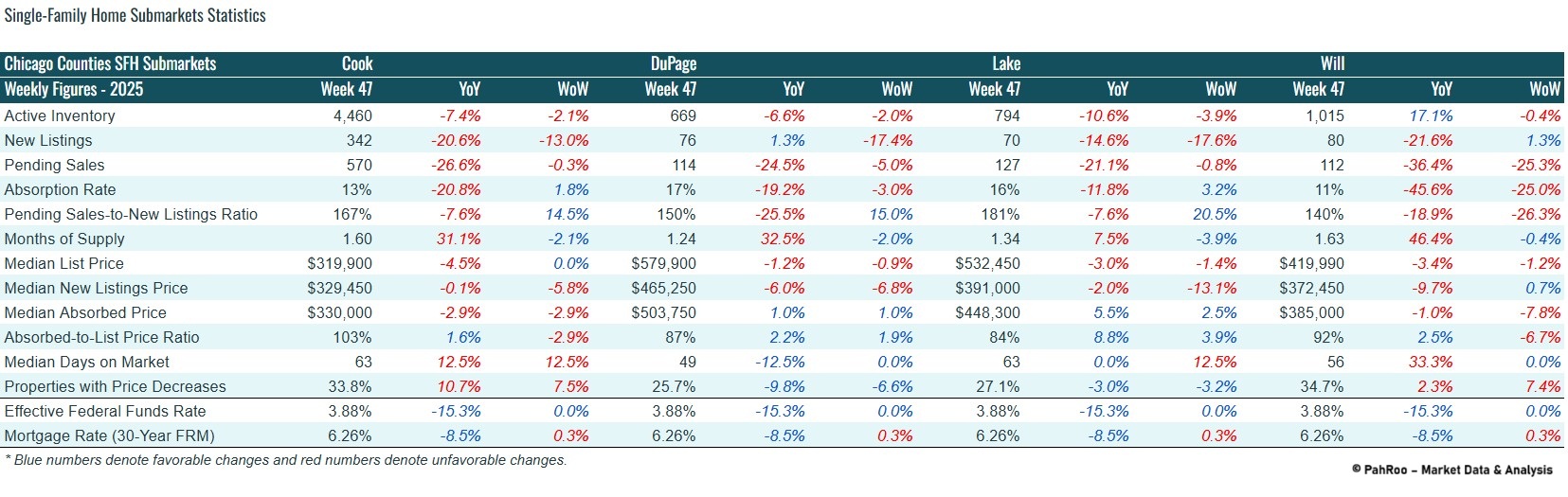
Chicago real estate market trends for Week 47 of 2025 showing declines in new listings and pending sales.

Inventory Tightens as New Listings Decline 

Across most Chicago-area counties, the number of homes for sale continues to shrink.
According to the data in the report: 

  • Single-family new listings dropped as much as 20.6% in Cook and 21.6% in Will County.
  • Condo listings declined by nearly 20% in Cook and 37% in Lake County.
  • Active inventory fell in Cook, DuPage, and Lake for single-family homes.

The only exception is Will County, which showed a 17.1% increase in active single-family inventory, a sign of local shifts or catch-ups from earlier shortages. 

What's In It For You

If you’re a seller in Cook, Lake, or DuPage County, you’re competing with fewer listings, giving your home more visibility. Buyers, however, may find fewer options and more competition in certain neighborhoods. 

Sellers can benefit from a professional appraisal to understand how current pricing trends impact their latest market value.

Pending Sales Drop as Buyers Hesitate 

Demand softened significantly: 

  • Single-family pending sales fell 20–36% year-over-year.
  • Condo pending sales dropped as much as 52% in some submarkets. 

Buyer hesitation reflects persistent affordability concerns and cautious sentiment due to mortgage rates and economic uncertainty. 

What's In It For You
  1. If you’re a buyer, slower sales mean negotiation power.
  2. If you’re a seller, expect longer timelines and be strategic with pricing. 
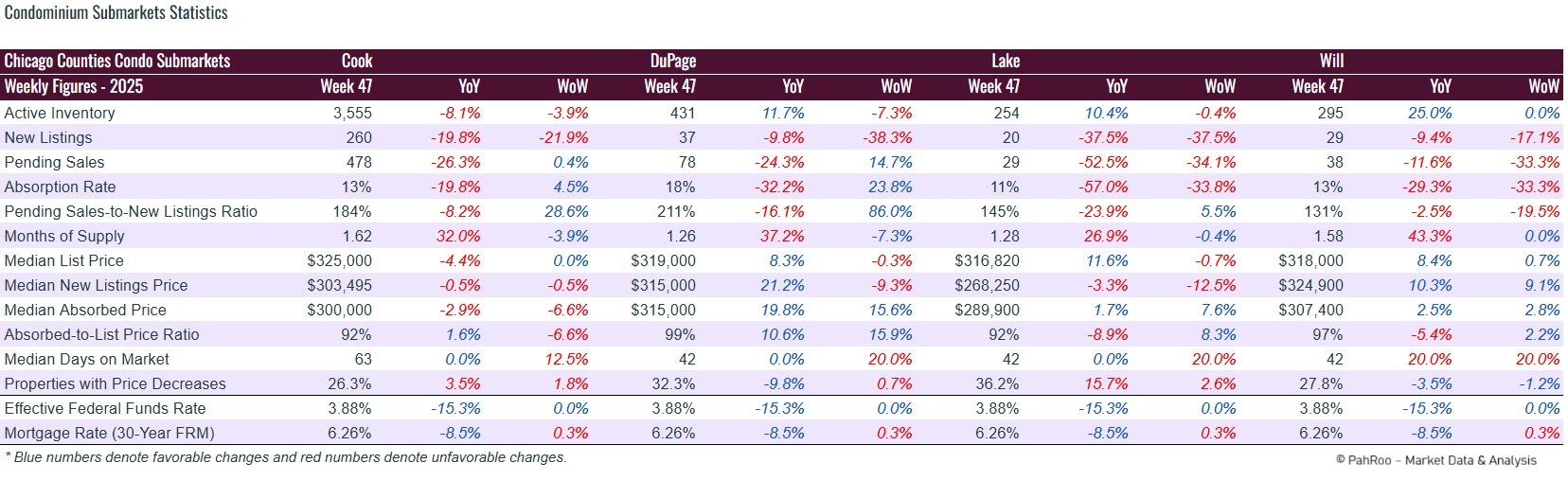
Data Cook, DuPage, Lake, and Will counties used in Chicago housing market analysis for 2025.

Mortgage & Federal Reserve Impact 
  • 30-year fixed mortgage rate: 6.26% (down 8.5% YoY)
  • Effective federal funds rate: 3.88%

While rates are lower than last year, they remain high enough to cool buyer activity. This aligns with the slower transaction volume and longer days on market. Current rate trends can be tracked through the Freddie Mac PMMS and Federal Reserve rate updates.

Pricing Trends: Softening but Strategic 

Price behavior is mixed: 

  • Single-family median list prices fell 1–4.5% across all counties.
  • Condos saw more price stability, with DuPage and Lake showing YoY gains in median list and absorbed prices.

Many submarkets also had higher percentages of price reductions, indicating active price negotiations.

What's In It For You
  1. Buyers may find more room to negotiate.
  2. Sellers should price competitively from the start to avoid unnecessary reductions. 
Homes Take Longer to Sell 

Days on market is a clear indicator of market speed: 

  • Single-family DOM increased by 12–33% in Cook, Lake, and Will.
  • Condos showed similar patterns, with many counties seeing 20% increases.

As shown in the Market Health tables, the slower pace reflects cautious buyers and the need for competitive pricing. 

Actionable Insights for Today’s Market 
  • Buyers → More negotiation power, slower pace, better value opportunities. 
  • Sellers → Less competition in some counties but must price strategically. 
  • Investors → A cooling market may present buying opportunities, especially where inventory is rising (e.g., Will County). 
The Market Wrap-Up 

The Week 47 Chicago real estate update reveals a market adjusting to interest rates, shifting consumer confidence, and evolving supply-and-demand dynamics. Well-priced, move-in–ready homes continue to attract attention, but buyers are taking their time, making data-driven strategies essential for both sides of the transaction. 

To understand how these trends affect your plans, request an appraisal or get your home’s valuation to see your standing in the current market.


Chicago commercial building whose Cook County property tax assessment is under appeal
Chicago Commercial Property Tax Appeals, Explained

Every spring, Cook County mails out assessment notices. Every year, a share of them value commercial buildings at numbers the market no longer supports. Chicago commercial property tax appeals exist for exactly that gap. The appeal is not a favor and not a loophole. It is the built-in correction step of a mass assessment system, and owners who skip it simply pay the error.

By the end of this article, you’ll know:

  • How the Cook County appeal process actually runs, step by step.
  • Why the calendar matters, township by township, with 2027 ahead.
  • What evidence wins, and where a preliminary opinion of value fits.

How Chicago Commercial Property Tax Appeals Work

Start with how the bill is built. In Cook County, most commercial property is assessed at 25% of its fair market value. The state then applies an equalization factor, local exemptions come off, and the taxing bodies’ levies set the rate. So the assessor’s opinion of market value sits at the base of the whole calculation. If that opinion is too high, every step after it inflates the bill.

The appeal ladder has three rungs. First, owners can appeal to the Cook County Assessor when their township opens. Second, the Cook County Board of Review hears appeals as a separate, quasi-judicial body, and filing there does not require an Assessor appeal first. Third, owners who disagree with the Board’s decision can take the case on to the Illinois Property Tax Appeal Board. Most commercial cases are won or lost at the Board of Review, so that hearing is where the evidence file earns its keep.

The Calendar Runs by Township, and 2027 Is Coming

Appeal windows open township by township every year, and the Board of Review publishes those dates each season. Miss a window and you wait for the next cycle, not forever. Still, a missed year is a year of overpayment that never comes back.

Then there is the bigger date. The City of Chicago gets reassessed in 2027 under the county’s triennial cycle, so every commercial parcel in the city receives a fresh value. For office owners staring at a downtown market with vacancy near 27%, that notice will matter. Evidence gathered now does double duty. It supports this year’s appeal, and it becomes the response file when the 2027 number lands.

Evidence Wins Appeals. Opinions Do Not.

The Board of Review does not reduce assessments because an owner feels overtaxed. It responds to valuation evidence: rent rolls and concession data that show real income, comparable sales that show current cap rates, and documented costs that reduce net operating income. We covered how review bodies stress-test those inputs in our piece on NOI and cap rates under scrutiny, and the office-specific version of the story in our downtown office tax appeal breakdown.

The pattern holds across property types. A retail strip with two dark anchors, a warehouse with functional problems, a loop tower with a half-empty rent roll. In each case, the winning file reads like a lender’s underwriting package. After all, those are the numbers the market itself uses to price the building.

What Commercial Appeals Mean for Homeowners

There is a public debate here, and it deserves a straight answer. Property taxes in Illinois are levy-based. The taxing bodies decide how much to collect, and the assessed values decide how the total gets split. So when commercial assessments come down on appeal, the same levy spreads across the remaining base, and some burden shifts toward residential owners. That shift is real, and it is why commercial reductions draw headlines.

The honest framing is this: an appeal does not ask for a discount. It asks for the correct value. A building taxed above its market value is subsidizing everyone else, and a building taxed below it does the reverse. The fix for fairness runs through accurate values on both sides, which is also why documentation standards at the Board keep rising.

Where a Preliminary Opinion of Value Fits

Not every parcel justifies a full appraisal, and nobody wants to find that out after paying for one. A preliminary opinion of value screens a property or a whole portfolio against current market evidence first. Then it flags where the assessment-to-value gap is worth pursuing. Attorneys and owners can request a preliminary review directly. Where the gap is real, a full USPAP-compliant commercial appraisal carries the case at the hearing, with testimony behind it when needed.

Treat the Appeal as a Valuation Case

Chicago commercial property tax appeals reward preparation and punish improvisation. The process is annual, the rungs are known, and the 2027 reassessment is on the calendar. So the move is simple to describe and hard to shortcut. Screen the portfolio, build the evidence file once, and use it at every rung that needs it. The owners who treat the appeal as a valuation case, not a complaint, are the ones who stop overpaying.

Paying taxes on a value the market left behind?

Start with the valuation evidence. PahRoo builds appeal files that hold up at the Board of Review.

Get My Appeal Quote

Frequently Asked Questions

Do I appeal with the Assessor or the Board of Review?

You can do either or both. The Assessor hears appeals when your township opens, and the Board of Review hears them separately as a quasi-judicial body. Filing at the Board does not require an Assessor appeal first. Most commercial cases are decided at the Board of Review stage.

Can I appeal my commercial assessment every year?

Yes. Cook County appeal windows open township by township every year, even outside reassessment years. An appeal corrects one year’s value, so owners with a persistent gap between assessment and market value often appeal annually.

What happens if the Board of Review denies my appeal?

The case can continue at the Illinois Property Tax Appeal Board, which reviews Board of Review decisions. In practice, the strength of the valuation evidence matters more at each rung, so the file built for the Board of Review keeps working.

Do commercial appeals raise taxes for homeowners?

They can shift some burden, because Illinois property taxes are levy-based. When one property’s assessed value falls, the same levy spreads across the remaining base. The counterpoint: a building taxed above its market value was overpaying, and accurate values on all properties are what make the split fair.

Does PahRoo file the appeal itself?

PahRoo provides the valuation side: preliminary opinions of value to screen properties, full USPAP-compliant appraisals, and testimony when a hearing needs it. Attorneys typically handle the filing and advocacy for commercial cases, and we work alongside them throughout.

Valuation Evidence for Cook County Appeals

PahRoo Appraisal & Consultancy has worked Cook County tax appeals for over two decades. An appraiser holding both MAI and SRA designations leads the firm. The work runs from portfolio screening through preliminary opinions of value to full appraisals and hearing testimony, for owners and for the attorneys who represent them.


NEWSLETTER

Knowing a property's true value is key
to making informed real estate decisions

Visit us

7383 Lincoln Ave Suite,
#100 Lincolnwood, IL, 60712