
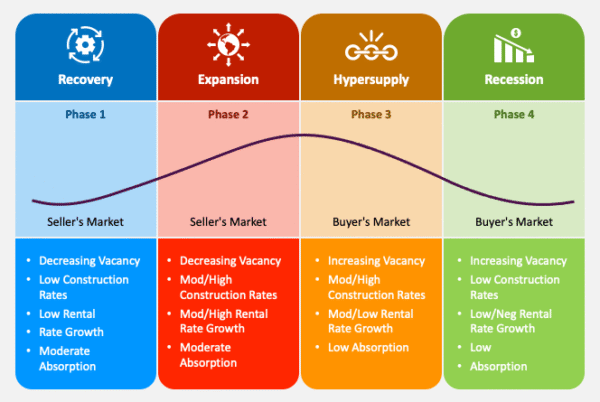
Real estate does not move in a straight line. It moves through a real estate market cycle, four repeating phases that shape when homes sell fast, when they sit, and when prices swing in your favor. If you are planning a purchase, a sale, or a refinance in Cook County or one of the other markets we serve, knowing where your local market sits in that cycle changes your timing and your negotiating position.
By the end of this article, you’ll know:
- The four phases of the real estate market cycle and what drives each one
- Where current data puts the national market, and how Chicago compares
- Why an appraiser factors cycle position into a defensible valuation
Understanding the Real Estate Market Cycle
Property markets move in patterns of supply and demand, not random swings. Dr. Glenn Mueller at the University of Denver’s Burns School of Real Estate has tracked this pattern across more than 50 U.S. metro areas for decades through his Cycle Monitor research. His work breaks the real estate market cycle into four phases: recovery, expansion, hypersupply, and recession. Every metro area moves through these phases at its own pace, but the sequence itself rarely changes. That consistency is what makes the cycle useful for planning, even though no two markets hit each phase on the same calendar.
The Four Phases and What Each One Means for Your Timing
Recovery
Vacancy is falling from a high point, but rents and prices have not caught up yet. Headlines still sound cautious. This is usually where the best long-term purchases happen, because pricing has not reflected the improving fundamentals. If you can hold a property for several years, recovery rewards patience.
Expansion
Confidence returns. New construction picks up, competition among buyers increases, and prices climb at a steady pace. If you bought during recovery, expansion is often the strongest window to sell or refinance, since demand is outpacing new supply.
Hypersupply
Construction catches up to demand and then overshoots it. Listings sit longer, price growth slows, and the first soft spots appear in specific neighborhoods or property types before they show up in national averages. Sellers should move with realistic pricing here. Buyers should confirm the deal holds up on its own merits, not just on the assumption that values keep rising.
Recession
Demand falls below the level supply can absorb. Prices soften and negative headlines dominate coverage. This phase is uncomfortable to sit through, but it also sets up the next recovery. Buyers with cash and a long time horizon often find their best opportunities here.
Where the Market Sits Right Now
National data from the National Association of REALTORS shows existing home sales still running below pre-pandemic norms in 2026, with inventory improving but not yet back to a balanced five to six months of supply nationally. That points to a market transitioning out of hypersupply in some regions while staying tighter than average in others. Illinois has landed on the tighter side, with home prices up close to 5% year over year even as several Sun Belt states post outright declines. That divergence matters. A market that looks like early hypersupply in Phoenix or Naples can still behave like expansion in parts of Cook County. Our recent look at the Chicago condo market in mid-2026 found the cooling concentrated in the suburbs while the city core held firmer, which is exactly the kind of local divergence a national headline will miss.
If you are weighing a move in Chicago, Dallas, Philadelphia, Phoenix, or Naples, the national cycle position is a starting point, not an answer. Your neighborhood, property type, and price band each carry their own timing.
How Cycle Position Shows Up in an Appraisal
An appraiser does not guess at cycle position from headlines. We track absorption rates, days on market, and the direction of recent comparable sales for the specific property type and price range in question. That data point, not a general sense of “the market is hot,” is what supports a defensible opinion of value under USPAP.
Cycle position also affects Cook County property tax strategy. A property assessed during a hypersupply or recession phase, when comparable sales are softening, often has stronger grounds for a reduction than one assessed at the peak of expansion. If your reassessment notice landed during a cooling window, it is worth reviewing whether the assessed value still reflects current market conditions. Our 2026 Cook County reassessment guide walks through how that evidence gets built into an appeal.
Know Your Local Phase Before You Move
National forecasts are a decent starting point, but they will not tell you what is happening on your block. Before you list, buy, or refinance, get an opinion of value grounded in your specific neighborhood’s cycle position, not a national average. That is the difference between a decision based on data and one based on a headline.
Get a Cycle-Informed Valuation Before You List or Buy
PahRoo appraisers track local absorption and comparable sales trends across Chicago, Dallas, Philadelphia, Phoenix, and Naples, so your valuation reflects where your market actually stands, not a national headline.
Frequently Asked Questions
What are the four phases of the real estate market cycle?
Recovery, expansion, hypersupply, and recession. Recovery is the trough where vacancy is falling but prices lag. Expansion brings rising demand and new construction. Hypersupply is when new supply overshoots demand and listings linger. Recession is when demand falls below what supply can absorb and prices soften.
How can I tell what phase my local market is in right now?
Look at absorption rate, days on market, and the direction of recent comparable sales for your specific property type and neighborhood. National data sets the broad backdrop, but local trends can run a full phase ahead of or behind the national picture.
Is 2026 a buyer’s market or a seller’s market?
It depends heavily on location. National inventory is still below pre-pandemic norms, but Sun Belt states like Florida and Arizona are seeing price declines while Illinois and parts of the Midwest are still posting price gains near 5% annually. Ask about your specific submarket rather than relying on the national average.
Does an appraiser account for market cycle position in a valuation?
Yes. A USPAP-compliant appraisal weighs absorption trends and recent comparable sales for the property’s specific type and price range, which reflects where that submarket sits in the cycle rather than relying on general market sentiment.
Does market cycle timing matter for a Cook County property tax appeal?
It can. A property assessed near the peak of expansion may carry a higher value than current comparable sales support if the market has since cooled toward hypersupply or recession. A current, well-documented appraisal helps show whether the assessed value still matches market conditions.
Need an Independent Appraisal?
Whether you are timing a sale in residential real estate, weighing a commercial acquisition, or reviewing a Cook County reassessment notice, PahRoo Appraisal & Consultancy can give you a valuation grounded in current, local market data. Contact us to talk through your specific situation.