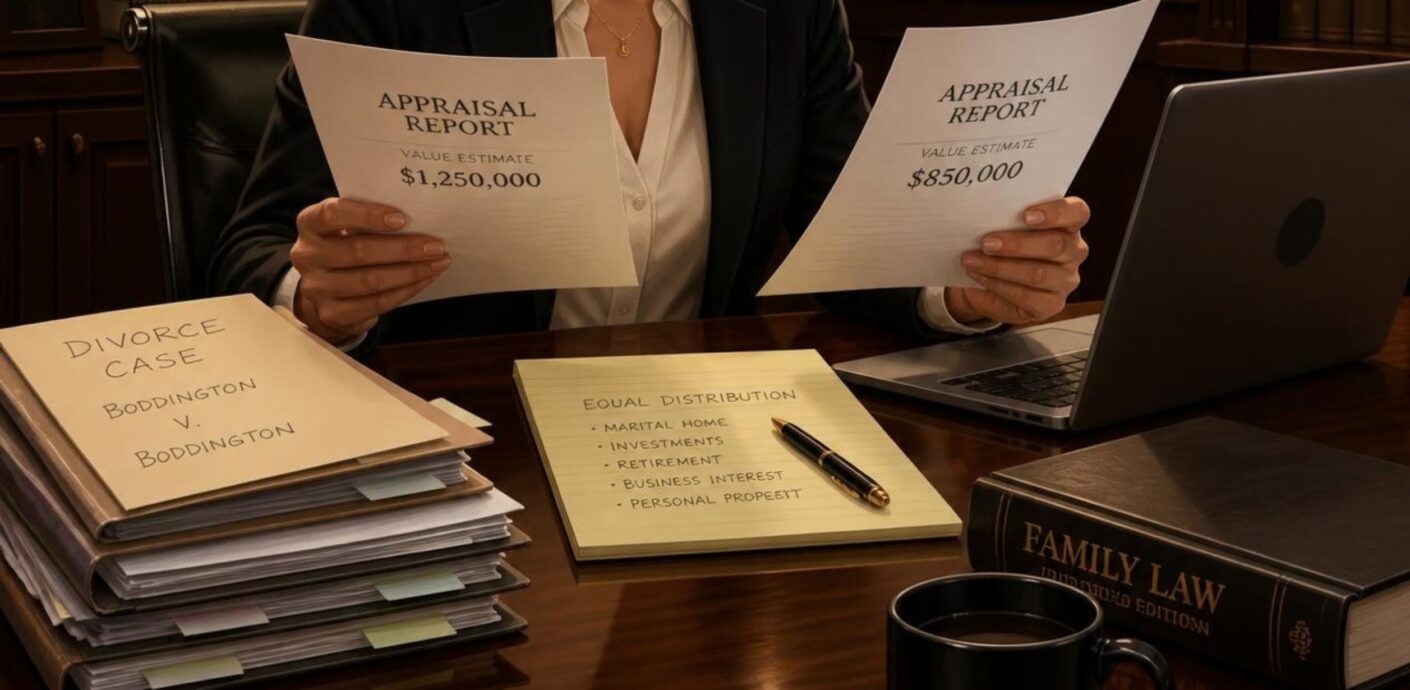
Two appraisers walk the same Park Ridge house a few weeks apart. One report says $985,000 and the other says $840,000. It’s a hypothetical, but family law attorneys will recognize it. The competing appraisals divorce counsel bring to trial rarely disagree about everything. Usually the $145,000 sits in three or four specific choices, and each one can be found. So before anyone attacks the other side’s number, it pays to find out where the gap lives.
- The five places two reports on the same house usually split
- A step-by-step way to trace the gap to its sources before the deposition
- What a rebuttal review covers, and what the CPA should do with two values
Why Competing Appraisals Divorce Courts See Rarely Match
Two competent appraisers can reach different values without either one being careless. An appraisal is an opinion built from data, and the choices stack up. In my experience the split shows up in five places.
The first is the date. Under 750 ILCS 5/503, the court uses fair market value as of the trial date, or another date the parties agree to or the court orders. If one report carries a March date and the other an October date, they measure two different markets. Our article on the date of value in a divorce appraisal covers how that date gets set.
The second is the house itself. One appraiser measured 3,150 square feet, and the other pulled 2,900 from the assessor’s record. One saw the finished basement, while the other never got past the kitchen because a spouse cut the visit short. Measurement method matters too. Fannie Mae has required the ANSI measuring standard on its loans since April 2022, but a divorce assignment isn’t a Fannie Mae loan. So ask each appraiser how the living area was measured.
The third is comparable selection, and it usually carries the most dollars. Two sales from a stronger school boundary or a newer subdivision will pull a value up. Leaving out the one sale that didn’t fit will do the same. The fourth is the adjustments: what each appraiser added or subtracted for size, condition, and location, and what market evidence backs each figure. The fifth is reconciliation, meaning which sales got the most weight at the end and why.
Trace the Gap Before You Attack the Number
Put the two reports side by side and work through them in order. It’s the same sequence I follow when counsel sends me an opposing report.
- Match the assignment terms. Compare the effective date, the definition of value, and the intended use on the first pages.
- Match the property. Compare living area, room count, lot size, condition rating, and what each appraiser inspected.
- Compare the sales. List every comparable in both reports, then mark the ones only one appraiser used.
- Compare adjustments on shared sales. If both used the same sale and adjusted it differently, that difference is pure judgment.
- Read both reconciliations. See which sales each appraiser leaned on at the end.
- Put a dollar figure on each difference. Then you know which fights matter.
Here is how that might run on the Park Ridge example. The 250 square feet of disputed living area, at a hypothetical $120 per square foot adjustment, accounts for $30,000. A seven-month difference in effective dates might explain $25,000. One appraiser rated the kitchen as updated and the other as average, worth perhaps $40,000. Then the last $50,000 comes from two sales in a stronger pocket that only one report used. Together those four items make up the full $145,000.
Now the dispute looks different. Two of the four items are facts. A tape measure settles the square footage, and the court’s order settles the date. Only the condition rating and the comparable selection are judgment calls, and they total $90,000. In practice, that is the real fight.
What the Judge Has to Work With
Section 503 requires the court to make specific factual findings on values. When the experts disagree, the judge resolves it as the trier of fact. Illinois appellate courts have long said that conflicts in valuation testimony are for the trial court. One 1998 decision added that a valuation within the range the experts testified to ordinarily will not be disturbed on appeal. How that applies to your case is counsel’s call. But from where I sit, it means the judge doesn’t have to adopt one report whole. A number in between is possible too.
So credibility is the contest. A judge reading two reports looks for the appraiser who verified the sales, supported each adjustment with market evidence, and inspected the whole property. Then cross-examination tests whether the explanation holds. We covered that test in what makes an appraisal defensible on the witness stand.
The statute also offers a third route. Under 503(l), the court may seek advice from its own financial experts or other professionals. That advice must be in writing, and counsel may examine the professional as a witness. So a third opinion can enter the case even if neither side orders one.
What a Rebuttal Appraisal Review Does
A rebuttal is usually an appraisal review. USPAP defines appraisal review as developing an opinion about the quality of another appraiser’s work, and Standards 3 and 4 govern it. The Appraisal Institute guidance on reviews makes two points attorneys should know. A reviewer evaluates the work, not the person. And a reviewer may or may not develop a separate opinion of value.
That second point shapes the engagement. A review without a value tells the court where the opposing report lacks support. A review with a value also gives the court another number, and the reviewer then has to support it like any appraisal. Sometimes the first kind is enough, because your retained appraiser’s report already supplies the value. So decide which one you need before you order it.
Timing matters as well. A reviewer needs the full opposing report, and ideally the workfile, well before the deposition. If you haven’t picked the person yet, our list of questions to ask an expert witness appraiser applies to reviewers too. One caution, though. The review should stay in the appraiser’s lane. Opinions about the other expert’s motives belong to counsel.
For the CPA Carrying Two Values Into the Schedules
Accountants often get both reports before anyone resolves the dispute, and the marital balance sheet still has to get built. Three habits keep your work clean.
First, don’t average the two numbers. An average has no effective date, no comparables, and no appraiser to defend it. Instead, run the balance sheet twice and show both. On the Park Ridge example, a $145,000 gap with an equal split of equity moves the equalizing payment by $72,500. That figure tells counsel what the fight is worth.
Second, check each report’s effective date against your own schedules. If the business valuation and the account balances are as of one date and an appraisal is as of another, say so in a footnote. Third, ask counsel for the gap analysis described above. Once you know $55,000 of the difference is date and square footage, you can model the likely range instead of the extremes.
Narrow the Fight to What Is Actually in Dispute
Most dueling appraisals get closer once someone does the tracing. So do it early. Stipulate to the effective date and the living area if you can, because those are facts. Then have a qualified reviewer put the remaining differences in writing, with a dollar figure on each. If the gap survives that, you’ll go into the deposition knowing which two or three questions matter. If it doesn’t, you may have found the settlement range instead. Our guide to disputed property value in an Illinois divorce lists the records to pull first.
Opposing Appraisal Just Landed on Your Desk?
Send us both reports. PahRoo prepares appraisal reviews under USPAP Standards 3 and 4 that show where the two values split and what each difference is worth. Michael Hobbs, MAI, SRA, signs our Illinois litigation work and testifies to it.
Frequently Asked Questions
What happens when two appraisals disagree in court?
The judge decides value as the trier of fact. Each appraiser testifies and faces cross-examination, and the court weighs which opinion has better support. Under 750 ILCS 5/503, an Illinois court must make specific findings on the value of the property it divides.
Why do two appraisals of the same house differ so much?
Usually for a handful of traceable reasons: different effective dates, different measurements or condition ratings, different comparable sales, different adjustments, and different weight in the final reconciliation. Putting a dollar figure on each one shows which differences are facts and which are judgment.
How does a judge decide between competing appraisals?
By credibility and support. Judges look at whether the appraiser inspected the property, verified the sales, backed each adjustment with market evidence, and held up under cross-examination. Illinois appellate decisions say conflicts in valuation testimony are for the trial court to resolve.
What is a rebuttal appraisal?
Most often it is an appraisal review: a second appraiser’s written opinion about the quality of the other side’s report, prepared under USPAP Standards 3 and 4. The reviewer may stop there or may also develop a separate opinion of value.
Can you get a third appraisal?
Yes. Either side can retain another appraiser, subject to the court’s disclosure deadlines. Under 750 ILCS 5/503(l), an Illinois court may also seek written advice from its own financial experts or other professionals. Whether a third opinion helps is a strategy question for counsel.
Appraisal Review and Testimony for Contested Divorce Cases
When a second report turns a valuation into a dispute, family law attorneys and forensic accountants call PahRoo Appraisal & Consultancy. From our Lincolnwood office we prepare divorce appraisals and appraisal reviews across Chicago and Cook County, and the firm also works in Dallas-Fort Worth, Philadelphia, Phoenix, and Naples. Michael Hobbs, MAI, SRA, founded the firm and is available for deposition and trial in Cook County. See our residential appraisal services, or contact us with both reports and the disclosure deadline.