Tag: Property Value Dispute

Request a quote

Our blog

Latest news
& events

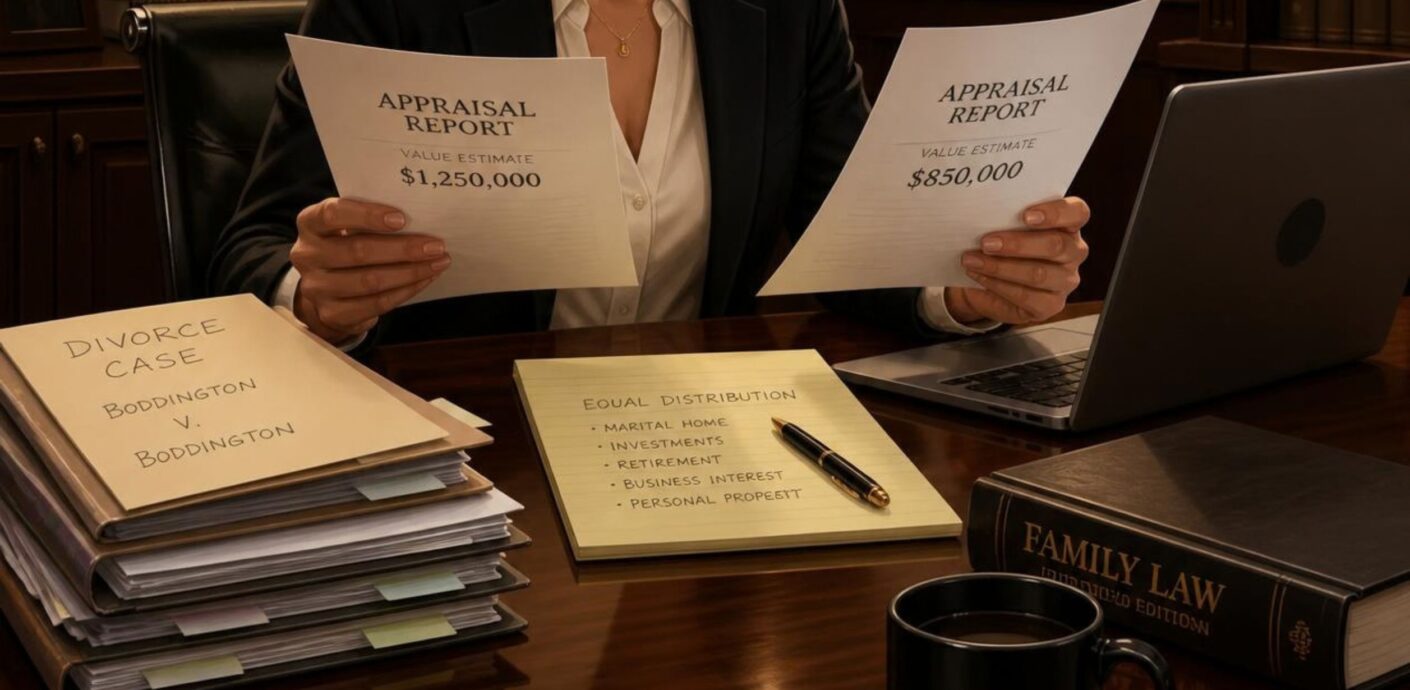
Attorney comparing two competing appraisals in a divorce case side by side on a conference table
When Two Appraisals of the Same House Disagree in Court

Two appraisers walk the same Park Ridge house a few weeks apart. One report says $985,000 and the other says $840,000. It’s a hypothetical, but family law attorneys will recognize it. The competing appraisals divorce counsel bring to trial rarely disagree about everything. Usually the $145,000 sits in three or four specific choices, and each one can be found. So before anyone attacks the other side’s number, it pays to find out where the gap lives.

By the end of this article, you’ll know:

  • The five places two reports on the same house usually split
  • A step-by-step way to trace the gap to its sources before the deposition
  • What a rebuttal review covers, and what the CPA should do with two values

Why Competing Appraisals Divorce Courts See Rarely Match

Two competent appraisers can reach different values without either one being careless. An appraisal is an opinion built from data, and the choices stack up. In my experience the split shows up in five places.

The first is the date. Under 750 ILCS 5/503, the court uses fair market value as of the trial date, or another date the parties agree to or the court orders. If one report carries a March date and the other an October date, they measure two different markets. Our article on the date of value in a divorce appraisal covers how that date gets set.

The second is the house itself. One appraiser measured 3,150 square feet, and the other pulled 2,900 from the assessor’s record. One saw the finished basement, while the other never got past the kitchen because a spouse cut the visit short. Measurement method matters too. Fannie Mae has required the ANSI measuring standard on its loans since April 2022, but a divorce assignment isn’t a Fannie Mae loan. So ask each appraiser how the living area was measured.

The third is comparable selection, and it usually carries the most dollars. Two sales from a stronger school boundary or a newer subdivision will pull a value up. Leaving out the one sale that didn’t fit will do the same. The fourth is the adjustments: what each appraiser added or subtracted for size, condition, and location, and what market evidence backs each figure. The fifth is reconciliation, meaning which sales got the most weight at the end and why.

Trace the Gap Before You Attack the Number

Put the two reports side by side and work through them in order. It’s the same sequence I follow when counsel sends me an opposing report.

  1. Match the assignment terms. Compare the effective date, the definition of value, and the intended use on the first pages.
  2. Match the property. Compare living area, room count, lot size, condition rating, and what each appraiser inspected.
  3. Compare the sales. List every comparable in both reports, then mark the ones only one appraiser used.
  4. Compare adjustments on shared sales. If both used the same sale and adjusted it differently, that difference is pure judgment.
  5. Read both reconciliations. See which sales each appraiser leaned on at the end.
  6. Put a dollar figure on each difference. Then you know which fights matter.

Here is how that might run on the Park Ridge example. The 250 square feet of disputed living area, at a hypothetical $120 per square foot adjustment, accounts for $30,000. A seven-month difference in effective dates might explain $25,000. One appraiser rated the kitchen as updated and the other as average, worth perhaps $40,000. Then the last $50,000 comes from two sales in a stronger pocket that only one report used. Together those four items make up the full $145,000.

Now the dispute looks different. Two of the four items are facts. A tape measure settles the square footage, and the court’s order settles the date. Only the condition rating and the comparable selection are judgment calls, and they total $90,000. In practice, that is the real fight.

What the Judge Has to Work With

Section 503 requires the court to make specific factual findings on values. When the experts disagree, the judge resolves it as the trier of fact. Illinois appellate courts have long said that conflicts in valuation testimony are for the trial court. One 1998 decision added that a valuation within the range the experts testified to ordinarily will not be disturbed on appeal. How that applies to your case is counsel’s call. But from where I sit, it means the judge doesn’t have to adopt one report whole. A number in between is possible too.

So credibility is the contest. A judge reading two reports looks for the appraiser who verified the sales, supported each adjustment with market evidence, and inspected the whole property. Then cross-examination tests whether the explanation holds. We covered that test in what makes an appraisal defensible on the witness stand.

The statute also offers a third route. Under 503(l), the court may seek advice from its own financial experts or other professionals. That advice must be in writing, and counsel may examine the professional as a witness. So a third opinion can enter the case even if neither side orders one.

What a Rebuttal Appraisal Review Does

A rebuttal is usually an appraisal review. USPAP defines appraisal review as developing an opinion about the quality of another appraiser’s work, and Standards 3 and 4 govern it. The Appraisal Institute guidance on reviews makes two points attorneys should know. A reviewer evaluates the work, not the person. And a reviewer may or may not develop a separate opinion of value.

That second point shapes the engagement. A review without a value tells the court where the opposing report lacks support. A review with a value also gives the court another number, and the reviewer then has to support it like any appraisal. Sometimes the first kind is enough, because your retained appraiser’s report already supplies the value. So decide which one you need before you order it.

Timing matters as well. A reviewer needs the full opposing report, and ideally the workfile, well before the deposition. If you haven’t picked the person yet, our list of questions to ask an expert witness appraiser applies to reviewers too. One caution, though. The review should stay in the appraiser’s lane. Opinions about the other expert’s motives belong to counsel.

For the CPA Carrying Two Values Into the Schedules

Accountants often get both reports before anyone resolves the dispute, and the marital balance sheet still has to get built. Three habits keep your work clean.

First, don’t average the two numbers. An average has no effective date, no comparables, and no appraiser to defend it. Instead, run the balance sheet twice and show both. On the Park Ridge example, a $145,000 gap with an equal split of equity moves the equalizing payment by $72,500. That figure tells counsel what the fight is worth.

Second, check each report’s effective date against your own schedules. If the business valuation and the account balances are as of one date and an appraisal is as of another, say so in a footnote. Third, ask counsel for the gap analysis described above. Once you know $55,000 of the difference is date and square footage, you can model the likely range instead of the extremes.

Narrow the Fight to What Is Actually in Dispute

Most dueling appraisals get closer once someone does the tracing. So do it early. Stipulate to the effective date and the living area if you can, because those are facts. Then have a qualified reviewer put the remaining differences in writing, with a dollar figure on each. If the gap survives that, you’ll go into the deposition knowing which two or three questions matter. If it doesn’t, you may have found the settlement range instead. Our guide to disputed property value in an Illinois divorce lists the records to pull first.

Opposing Appraisal Just Landed on Your Desk?

Send us both reports. PahRoo prepares appraisal reviews under USPAP Standards 3 and 4 that show where the two values split and what each difference is worth. Michael Hobbs, MAI, SRA, signs our Illinois litigation work and testifies to it.

Request an Appraisal Review

Frequently Asked Questions

What happens when two appraisals disagree in court?

The judge decides value as the trier of fact. Each appraiser testifies and faces cross-examination, and the court weighs which opinion has better support. Under 750 ILCS 5/503, an Illinois court must make specific findings on the value of the property it divides.

Why do two appraisals of the same house differ so much?

Usually for a handful of traceable reasons: different effective dates, different measurements or condition ratings, different comparable sales, different adjustments, and different weight in the final reconciliation. Putting a dollar figure on each one shows which differences are facts and which are judgment.

How does a judge decide between competing appraisals?

By credibility and support. Judges look at whether the appraiser inspected the property, verified the sales, backed each adjustment with market evidence, and held up under cross-examination. Illinois appellate decisions say conflicts in valuation testimony are for the trial court to resolve.

What is a rebuttal appraisal?

Most often it is an appraisal review: a second appraiser’s written opinion about the quality of the other side’s report, prepared under USPAP Standards 3 and 4. The reviewer may stop there or may also develop a separate opinion of value.

Can you get a third appraisal?

Yes. Either side can retain another appraiser, subject to the court’s disclosure deadlines. Under 750 ILCS 5/503(l), an Illinois court may also seek written advice from its own financial experts or other professionals. Whether a third opinion helps is a strategy question for counsel.

Appraisal Review and Testimony for Contested Divorce Cases

When a second report turns a valuation into a dispute, family law attorneys and forensic accountants call PahRoo Appraisal & Consultancy. From our Lincolnwood office we prepare divorce appraisals and appraisal reviews across Chicago and Cook County, and the firm also works in Dallas-Fort Worth, Philadelphia, Phoenix, and Naples. Michael Hobbs, MAI, SRA, founded the firm and is available for deposition and trial in Cook County. See our residential appraisal services, or contact us with both reports and the disclosure deadline.

Family lawyer reviewing divorce property documents in Illinois
Disputed Property Value in Illinois Divorce: 3 Documents


The two numbers are $640,000 and $515,000, and each spouse is sure of theirs. Disputed property value in an Illinois divorce usually starts this way. One side quotes a listing site, the other a neighbor’s sale. Before anyone pays for an expert, three records already exist. They will tell you which number is closer, and whether either one is worth defending.

By the end of this article, you’ll know:

  • Which three records to request, where each one lives in Cook County, and what each can and cannot prove
  • The tells inside each record that point to a soft number on the other side
  • When the file needs an independent appraisal, and what a broker should hand over in the meantime

Why Disputed Property Value Gets Settled on Paper First

Illinois divides marital property in just proportions, not an automatic half. That comes from 750 ILCS 5/503, and the court applies it asset by asset. The house is often the largest line on the marital balance sheet, and the court has to land on a value before it can divide anything.

When spouses ask the judge to decide property, each one completes a financial affidavit with supporting documents, as Illinois Legal Aid Online explains. The value on that affidavit has to come from somewhere. Your job, early, is to find out where.

Three records answer that question at almost no cost. Each was created for a different purpose, so none is a value opinion you can take to trial. But together they show you the shape of the dispute. And they do it before you spend a dollar on an independent divorce appraisal.

Record One: The Assessor’s Property Record

Start with the Cook County Assessor. The office values about 1.8 million parcels, and it says plainly that it does not value them one at a time. It uses mass appraisal, a regression model that relates your client’s house to the sales around it. One-third of the county gets reassessed each year on a three-year cycle. The Board of Review then finalizes values after appeals.

Pull the property detail page by PIN. It shows the estimated market value, the assessed value, the property class, and the year of the next reassessment. It also shows an exemption history and a characteristics table: square footage, baths, basement, garage, age. Read the market value line, not the assessed line. For most homes the assessed figure is a fraction of the market estimate. A spouse who quotes it as the value misread the page.

A value reduced at the Board of Review means someone argued, in writing, that the house is worth less. If that same spouse now claims it is worth more, you have the exhibit. A table showing three baths and a full basement when the house has two and a crawl space means the record is wrong. An unpermitted addition or a finished lower level can push the gap the other way. Two homeowner exemptions across two properties is a separate problem your client should hear about now.

Consider a hypothetical Evanston bungalow. The Assessor’s estimated market value reads $480,000. One spouse claims $640,000 and the other claims $515,000. The record proves neither number, but it puts the burden where it belongs. The $640,000 figure sits $160,000 above a model built on nearby sales, so that spouse owes you a report.

Record Two: Any Prior Appraisal on the Property

If either spouse bought, refinanced, or opened a home equity line during the marriage, a lender appraisal exists. Ask for it in discovery, and ask the lender if the spouse cannot find it. It answers a lender’s question as of a lender’s date, so the value itself is stale. The rest of the report is not.

A prior appraisal gives you a measured square footage, a sketch, and interior photos. It also gives a condition rating, the updates the owner claimed at the time, and the comparable sales an independent appraiser chose back then. If one spouse says the kitchen was gutted in 2019, the 2021 refinance photos settle it. Under USPAP, the standard every licensed appraiser works to, the report must state its effective date and intended use. Hold it to that date. Then it is a record of what the house was, not an argument about what it is worth today. Our piece on the date of value in a divorce appraisal explains why that distinction moves settlements.

Three things deserve a second look. A value that lands exactly at the number the loan needed. A property described differently than it stands today, which can mean work done since, or work never done. And a report dated after a deed changed hands, because a quitclaim transfer mid-case changes which date the court cares about. When I get a prior appraisal in a new assignment, I do not adopt its value. I use it to check what changed and to confirm the square footage.

Record Three: Broker Price Opinions and Market Analyses

A broker price opinion, or the comparative market analysis most sellers see, is an agent’s estimate of what a home could list or sell for. In a divorce file they show which comparables each side leans on and whether a range is a listing range or a value. A pricing tool built to win a listing will not survive an opposing expert, which is why a divorce home appraisal and a price opinion land so differently in front of a judge.

If you are the broker being asked for that CMA, here is what makes yours useful instead of a liability. Date it. State on the first page that it is a pricing analysis and not an appraisal. List every comparable with its closed date, closed price, and any seller concessions you know about. Say whether you walked the interior or worked from photos. Then keep your file. In a contested case you may get a subpoena for it, and a range you stretched for one spouse is a bad afternoon under oath. A CMA that shows its work gets read alongside the appraisal. One that does not gets read against you.

For counsel, the practical move is to request both sides’ opinions at once and lay the comparables next to each other. If both agents used the same four sales and landed $90,000 apart, the difference is in the adjustments. That is an appraisal question. If they used different sales, someone is shopping for comps.

When the Paper Runs Out and the File Needs an Appraisal

The three records frame the dispute. They rarely end it. Order an independent appraisal when the gap survives the paper. Order one when the equity is large enough that a five percent error costs real money, or when a buyout or refinance depends on the number. The same goes for an unusual property, a rental unit, or a case likely to reach a hearing. A retrospective date, such as the date of marriage for a premarital equity claim, is its own reason. None of the records will give you one.

Online estimates do not fill the gap. In April 2026 the Appraisal Standards Board adopted Advisory Opinion 41 on automated valuation models, regression software, and generative AI in appraisal work. An appraiser who uses those tools still owns the result and has to support it. A spouse citing a website estimate has none of that behind the number.

Cook County adds a local wrinkle. A block in Oak Park, a two-flat in Hyde Park, and a bungalow in Norwood Park each sit in a market that moves on its own schedule. A report built for Cook County reads those markets and supports each adjustment. Our article on what makes an appraisal defensible on the witness stand goes through that test in detail.

Pull the Records Before the First Settlement Conference

The sequence is simple. Pull the Assessor’s property record on day one; it costs nothing and needs only a PIN. Put prior appraisals and any broker opinions in your first document request. Ask the lender directly if the spouse comes up empty. Lay the three records side by side and see where the gap lives: the square footage, the condition, the comparables, or the date. Then decide whether an appraisal is needed, and if so, agree the effective date with opposing counsel before either side orders one.

Two Numbers on the Table and No Way to Choose?

PahRoo prepares independent divorce appraisals for contested marital property across Cook County and the Chicago area, built to be disclosed, deposed, and defended.

Order an Independent Appraisal

Frequently Asked Questions

What documents should a family lawyer request when property value is disputed?

Request the county assessor’s property record, any prior purchase, refinance, or home equity appraisal, and any broker price opinion or comparative market analysis either spouse relied on. Together they show where the two numbers came from and whether an independent appraisal is needed.

Can a Cook County assessment be used as market value in a divorce?

Not as a value opinion. The Cook County Assessor values property by mass appraisal for tax purposes and does not inspect the individual home. The estimated market value is useful background, and the characteristics table and appeal history can expose errors, but it should not replace an appraisal when value is contested.

Is a broker price opinion the same as an appraisal?

No. A broker price opinion or comparative market analysis is a pricing tool prepared by a real estate agent, usually to set a listing price. An appraisal is an independent opinion of value developed under USPAP by a licensed or certified appraiser, with a stated effective date, intended use, and supported adjustments.

Can a prior refinance appraisal set the value in a divorce?

Rarely. The value in a refinance appraisal applies to the lender’s effective date, which is usually well before the divorce. The report is still valuable for its measured square footage, sketch, photos, condition notes, and comparable sales, which document what the house was on that date.

When should a divorce attorney order an independent appraisal?

When the gap between the spouses survives the three records, when the equity is large, when a buyout or refinance depends on the number, when the property is unusual or includes a rental unit, when a past effective date is needed, or when the case is likely to reach a hearing.

Appraisal Support for Contested Marital Property in Cook County

The records above are where PahRoo starts too. Since 1999 the firm has prepared divorce, estate, and litigation appraisals across Cook County and the wider Chicago area, along with Dallas-Fort Worth, Philadelphia, Phoenix, and Naples. Michael Hobbs, MAI, SRA, signs every report and is available for deposition and testimony. See our residential appraisal services, or contact us with the PIN and the records you already have.

NEWSLETTER

Knowing a property's true value is key
to making informed real estate decisions

Visit us

7383 Lincoln Ave Suite,
#100 Lincolnwood, IL, 60712