Tag: Housing Market Trends

Request a quote

Our blog

Latest news
& events

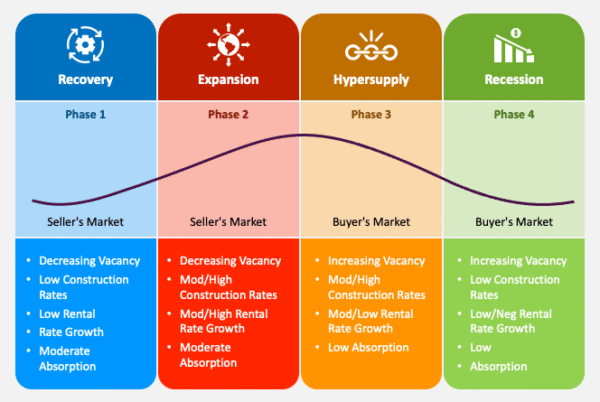
our phases of the real estate market cycle: recovery, expansion, hyper supply, and recession
Real Estate Cycles Explained: The Insider’s Guide to Buying or Selling at the Perfect Time

Real estate does not move in a straight line. It moves through a real estate market cycle, four repeating phases that shape when homes sell fast, when they sit, and when prices swing in your favor. If you are planning a purchase, a sale, or a refinance in Cook County or one of the other markets we serve, knowing where your local market sits in that cycle changes your timing and your negotiating position.

By the end of this article, you’ll know:

  • The four phases of the real estate market cycle and what drives each one
  • Where current data puts the national market, and how Chicago compares
  • Why an appraiser factors cycle position into a defensible valuation

Understanding the Real Estate Market Cycle

Property markets move in patterns of supply and demand, not random swings. Dr. Glenn Mueller at the University of Denver’s Burns School of Real Estate has tracked this pattern across more than 50 U.S. metro areas for decades through his Cycle Monitor research. His work breaks the real estate market cycle into four phases: recovery, expansion, hypersupply, and recession. Every metro area moves through these phases at its own pace, but the sequence itself rarely changes. That consistency is what makes the cycle useful for planning, even though no two markets hit each phase on the same calendar.

The Four Phases and What Each One Means for Your Timing

Recovery

Vacancy is falling from a high point, but rents and prices have not caught up yet. Headlines still sound cautious. This is usually where the best long-term purchases happen, because pricing has not reflected the improving fundamentals. If you can hold a property for several years, recovery rewards patience.

Expansion

Confidence returns. New construction picks up, competition among buyers increases, and prices climb at a steady pace. If you bought during recovery, expansion is often the strongest window to sell or refinance, since demand is outpacing new supply.

Hypersupply

Construction catches up to demand and then overshoots it. Listings sit longer, price growth slows, and the first soft spots appear in specific neighborhoods or property types before they show up in national averages. Sellers should move with realistic pricing here. Buyers should confirm the deal holds up on its own merits, not just on the assumption that values keep rising.

Recession

Demand falls below the level supply can absorb. Prices soften and negative headlines dominate coverage. This phase is uncomfortable to sit through, but it also sets up the next recovery. Buyers with cash and a long time horizon often find their best opportunities here.

Where the Market Sits Right Now

National data from the National Association of REALTORS shows existing home sales still running below pre-pandemic norms in 2026, with inventory improving but not yet back to a balanced five to six months of supply nationally. That points to a market transitioning out of hypersupply in some regions while staying tighter than average in others. Illinois has landed on the tighter side, with home prices up close to 5% year over year even as several Sun Belt states post outright declines. That divergence matters. A market that looks like early hypersupply in Phoenix or Naples can still behave like expansion in parts of Cook County. Our recent look at the Chicago condo market in mid-2026 found the cooling concentrated in the suburbs while the city core held firmer, which is exactly the kind of local divergence a national headline will miss.

If you are weighing a move in Chicago, Dallas, Philadelphia, Phoenix, or Naples, the national cycle position is a starting point, not an answer. Your neighborhood, property type, and price band each carry their own timing.

How Cycle Position Shows Up in an Appraisal

An appraiser does not guess at cycle position from headlines. We track absorption rates, days on market, and the direction of recent comparable sales for the specific property type and price range in question. That data point, not a general sense of “the market is hot,” is what supports a defensible opinion of value under USPAP.

Cycle position also affects Cook County property tax strategy. A property assessed during a hypersupply or recession phase, when comparable sales are softening, often has stronger grounds for a reduction than one assessed at the peak of expansion. If your reassessment notice landed during a cooling window, it is worth reviewing whether the assessed value still reflects current market conditions. Our 2026 Cook County reassessment guide walks through how that evidence gets built into an appeal.

Know Your Local Phase Before You Move

National forecasts are a decent starting point, but they will not tell you what is happening on your block. Before you list, buy, or refinance, get an opinion of value grounded in your specific neighborhood’s cycle position, not a national average. That is the difference between a decision based on data and one based on a headline.

Get a Cycle-Informed Valuation Before You List or Buy

PahRoo appraisers track local absorption and comparable sales trends across Chicago, Dallas, Philadelphia, Phoenix, and Naples, so your valuation reflects where your market actually stands, not a national headline.

Request Your Appraisal

Frequently Asked Questions

What are the four phases of the real estate market cycle?

Recovery, expansion, hypersupply, and recession. Recovery is the trough where vacancy is falling but prices lag. Expansion brings rising demand and new construction. Hypersupply is when new supply overshoots demand and listings linger. Recession is when demand falls below what supply can absorb and prices soften.

How can I tell what phase my local market is in right now?

Look at absorption rate, days on market, and the direction of recent comparable sales for your specific property type and neighborhood. National data sets the broad backdrop, but local trends can run a full phase ahead of or behind the national picture.

Is 2026 a buyer’s market or a seller’s market?

It depends heavily on location. National inventory is still below pre-pandemic norms, but Sun Belt states like Florida and Arizona are seeing price declines while Illinois and parts of the Midwest are still posting price gains near 5% annually. Ask about your specific submarket rather than relying on the national average.

Does an appraiser account for market cycle position in a valuation?

Yes. A USPAP-compliant appraisal weighs absorption trends and recent comparable sales for the property’s specific type and price range, which reflects where that submarket sits in the cycle rather than relying on general market sentiment.

Does market cycle timing matter for a Cook County property tax appeal?

It can. A property assessed near the peak of expansion may carry a higher value than current comparable sales support if the market has since cooled toward hypersupply or recession. A current, well-documented appraisal helps show whether the assessed value still matches market conditions.

Need an Independent Appraisal?

Whether you are timing a sale in residential real estate, weighing a commercial acquisition, or reviewing a Cook County reassessment notice, PahRoo Appraisal & Consultancy can give you a valuation grounded in current, local market data. Contact us to talk through your specific situation.

Luxury home interior representing a luxury real estate appraisal assignment
Luxury Real Estate Appraisal as the Buyer Pool Changes

Walk into a high-end open house today and the buyers look different than they did a decade ago. Younger, more often women buying on their own, and asking about smart systems instead of formal dining rooms. That shift changes more than marketing. It changes what a luxury real estate appraisal has to measure, and it is about to make documented values matter more than ever, because the largest wealth transfer in history is moving property along with the money.

By the end of this article, you’ll know:

  • Who the new luxury buyers are, and how much wealth is heading their way
  • Why high-end homes are the hardest properties to value, and where online estimates fail
  • Why the wealth transfer itself creates appraisal needs for estates, gifts, and trusts

The Buyers Are Changing, and So Is Luxury Real Estate Appraisal

For years, the top of the market belonged to Baby Boomers and Gen X. That is ending. Roughly $124 trillion in assets is projected to change hands through 2048, with about $106 trillion going to heirs, mostly Gen X, Millennials, and Gen Z, according to Cerulli Associates research summarized by Merrill and Bank of America Private Bank. Some of that inheritance arrives as cash that buys homes. A lot of it arrives as the homes themselves.

For a luxury real estate appraisal, the buyer pool is not trivia. Value is what the probable buyer would pay, so when the probable buyer changes, the analysis has to follow. An appraiser who still assumes a 1998 buyer profile will misread what today’s market rewards and what it ignores.

Why Luxury Homes Are the Hardest to Value

High-end properties break the tools that work everywhere else. Automated estimates lean on volume and similarity, and luxury homes offer neither. Sales are few, features are custom, and no two properties match. A $400,000 house might have a dozen recent comps within a mile. A $4 million house might have three loosely similar sales in a year, spread across neighborhoods.

So the appraiser has to work harder. That means widening the search area with care, verifying the terms behind each sale, adjusting for one-of-a-kind features with market support, and accounting for longer exposure times at the top of the market. This is the segment where designations and experience separate a defensible residential appraisal from an expensive guess.

What the New Buyers Pay For, and What They Do Not

Younger luxury buyers consistently favor smart-home technology, wellness spaces, energy performance, and turnkey condition. Sellers hear that and assume every upgrade returns its cost. The appraisal answers a colder question: what does the market actually pay for the feature?

Some of these amenities now carry real contributory value in the right submarkets. Others read as personal taste that the next buyer will renovate away. The discipline is the same one we described for green property features: cost is not value, and market evidence decides. In luxury, where a single feature can represent six figures, that distinction gets expensive to ignore.

Women Are a Growing Share of the Buyer Pool

The other structural shift is who holds the wealth. Women in the United States are projected to control about $34 trillion in assets by 2030, roughly 38 percent of the total, per McKinsey research. More high-end purchases are made by women buying independently, often through trusts or after a divorce or inheritance.

Those purchase paths share a common need: an independent value nobody can argue with. Trust purchases, divorce settlements, and estate distributions all put the number under scrutiny from trustees, attorneys, or courts. The appraisal is what keeps that scrutiny short.

The Wealth Transfer Is an Appraisal Event

Here is what the trend coverage misses. Every luxury property that passes between generations needs a documented value at the moment it moves. Estates need date-of-death values to set basis and settle fairly among heirs. Gifted property needs a supportable value for the paperwork the family’s CPA will file. Homes placed in trusts need values for funding and accounting. The tax mechanics belong to a CPA, but the value itself is appraisal work, and it has to hold up years later if anyone asks.

Families who handle this well get the appraisal at the time of transfer, not five years later when a dispute or an audit forces a retrospective reconstruction. With this much property set to change hands, the cheapest insurance in estate planning is a current, well-documented value from a qualified appraiser. Our estate planning appraisal work exists for exactly this moment.

Get the Value Documented Before the Asset Moves

If you own, advise on, or expect to inherit high-end property, the order of operations matters. Appraise before the transfer, before the listing, and before the settlement talks, while the facts are fresh and the market data is current. The new luxury market rewards buyers and families who know their number. It punishes the ones who guess.

Put a Defensible Number on a High-Value Property

PahRoo’s MAI and SRA designated appraisers value luxury and estate homes for purchases, trusts, estates, and settlements across Chicago, Dallas, Philadelphia, Phoenix, and Naples.

Request a Luxury Home Appraisal

Frequently Asked Questions

Why is a luxury home harder to appraise than a typical house?

Because comparable sales are scarce and the properties are one of a kind. The appraiser must widen the search, verify each sale’s terms, and support adjustments for custom features, which takes more skill and more market evidence than a standard assignment.

Can I rely on an online estimate for a high-end property?

No. Automated models depend on many similar recent sales, which luxury markets rarely provide. Estimates at the top of the market routinely miss by wide margins, in either direction, and carry no weight with courts, trustees, or the IRS.

Do smart home and wellness features increase appraised value?

Sometimes. The appraiser measures contributory value, meaning what buyers in that submarket actually pay for the feature, which is often less than installation cost. Well-documented, market-supported features fare best.

When does inherited or gifted property need an appraisal?

At the time of transfer. Estates typically need a value as of the date of death, and gifts need a supportable value for the related filings. Getting the appraisal when the property moves avoids a costlier retrospective reconstruction later. The tax treatment itself is a matter for your CPA.

How long does a luxury home appraisal take?

Longer than a standard assignment. The inspection alone can take several hours for a large custom home, and the research and reporting often run one to two weeks depending on how thin the comparable data is. Complex properties reward starting early.

Need an Independent Appraisal?

PahRoo Appraisal & Consultancy values luxury, estate, and unique residential properties across Chicago, Dallas, Philadelphia, Phoenix, and Naples. Led by Michael Hobbs, our MAI and SRA designated team delivers appraisals built to satisfy trustees, attorneys, and courts, not just curiosity.


NEWSLETTER

Knowing a property's true value is key
to making informed real estate decisions

Visit us

7383 Lincoln Ave Suite,
#100 Lincolnwood, IL, 60712