
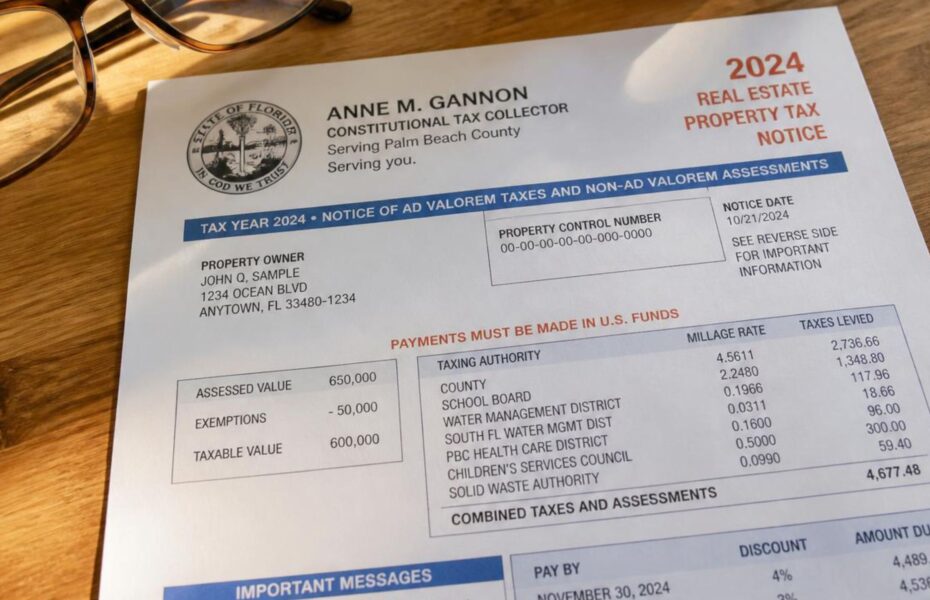
The Notice of Proposed Property Taxes hits Collier County mailboxes in the second half of August. The clock starts the day it is mailed, not the day it is opened. A TRIM notice appraisal answers the one question the Value Adjustment Board will actually decide. What was this property worth on January 1? For 2026, Collier’s petition deadline is September 11. That leaves attorneys and owners about a week to decide whether the number deserves a fight.
- The 2026 Collier County filing deadline, fee, and what has to be paid to keep a petition alive
- Who carries the burden at the VAB and what the evidence has to prove
- How a January 1 retrospective appraisal is built to meet that burden
The 25-Day Clock Behind a TRIM Notice Appraisal
Florida law gives a taxpayer until the 25th day after the property appraiser mails the notice to petition the Value Adjustment Board on a valuation issue. That rule sits in section 194.011 of the Florida Statutes. The board cannot extend it. Still, late petitions are possible. They need a good cause statement, and the VAB attorney decides whether to accept them.
Collier County has published its own date. The Collier Clerk’s Value Adjustment Board page sets the 2026 deadline at September 11. That means 5 p.m. in the office at 3299 Tamiami Trail East, or 11:59 p.m. online. The filing fee is $50 per petition per parcel for most petition types, payable at filing. The clerk rejects a petition without the fee. If the petition is not in by September 11, the 2026 value stands unless the owner goes to circuit court instead.
One more requirement trips up owners who file and forget. A petitioner challenging assessed value must pay at least 75 percent of the ad valorem taxes before they become delinquent, less the early payment discount. Miss that payment and the board must deny the petition by written decision.
What the Value Adjustment Board Weighs
The statute stacks the deck in a specific way. Under section 194.301, the property appraiser’s assessment is presumed correct once the appraiser shows it followed section 193.011 and professionally accepted appraisal practices, including mass appraisal standards. The challenger then carries the burden. By a preponderance of the evidence, the petitioner has to show the assessed value does not represent just value as of January 1. Or, that the appraiser reached it by practices not applied to comparable property in the county.
So the argument is never that the number feels high. It is that competent, substantial evidence in the record supports a different number under the appraiser’s own criteria. When the petitioner clears that bar, the board or special magistrate sets the value from the evidence in the record. When the record is thin, the matter can go back to the property appraiser with directions. It does not go to the owner’s preferred number.
Collier County, like every Florida county over 75,000 people, uses special magistrates to hear valuation petitions. A magistrate on a real estate valuation must be a state-certified appraiser with at least five years of experience. So the person reading the report is not a layperson. Someone who does this work will judge every adjustment, every comparable, and every reconciliation.
What a January 1 Appraisal Has to Do
Florida assesses as of January 1. So the appraisal is retrospective by definition. By the time a TRIM notice arrives in August, eight months of sales have closed that cannot set a January value. So the report has to reconstruct the market as it stood on the first of the year. That means sales that bracket the date, and market conditions adjustments that run to January 1 rather than to the inspection date.
The evidence exchange is where good reports separate from adequate ones. Under section 194.011(4), the petitioner must give the property appraiser a list of evidence, copies of every document the board will see, and a witness summary. All of it is due at least 15 days before the hearing. The property appraiser owes the petitioner the same on the same timeline, including the property record card. Read that card closely. Errors in living area, quality grade, or land size are among the cleanest grounds for a value change, and the easiest for a magistrate to accept.
Our piece on tax appeal appraisal evidence covers the Cook County version of these rules. The Florida version has its own quirks, and the largest is who can appear. Section 194.034 lets a Florida Bar attorney, a licensed real estate appraiser, a licensed broker, or a CPA represent the taxpayer. So can anyone holding a written authorization or power of attorney. In practice, the appraiser who wrote the report can present it, and an attorney can cross-examine the property appraiser’s staff on theirs.
A separate rule matters when choosing the appraiser. An appraisal cannot come in as evidence in any year its author serves as a special magistrate to that same board. Ask before engaging.
Where the Value Change Actually Reaches the Bill
For high-value Naples property, check the arithmetic before anyone files. A lower just value does not always mean a lower bill. Consider a hypothetical homesteaded Port Royal house with a just value of $6,000,000 on the notice. The Save Our Homes cap has held its assessed value near $3,500,000. So cutting just value to $5,400,000 changes nothing on this year’s bill. The capped assessed value still sits far below either number.
Now consider a second home on the Gulf, bought in 2024, with no homestead. Its assessed value tracks just value, subject to the ten percent non-homestead cap. So a $600,000 reduction in just value flows into taxable value. At a hypothetical combined millage near one percent, that is roughly $6,000 a year, every year the reduction holds. The same logic applies to a recently purchased homestead where the cap reset at sale. It applies to rental, commercial, and vacant land too. That is why the first question we ask a Naples owner is not what the notice says. It is whether the property is capped, and by how much.
The appraisal itself has to be built for the magistrate, not for the owner. We prepare Naples appraisals with a January 1 effective date and adjustments a certified appraiser can trace. Comparable sales are confirmed with the parties where possible. A report that leans on listing prices, or on sales that closed in June, will not survive the presumption of correctness. Nor should it.
Decisions, Appeals, and the Circuit Court Fallback
Once a petition is in, the clerk schedules the hearing at least 25 days out and notifies the petitioner in writing. Either side may reschedule once for good cause. After the hearing, the magistrate issues a recommended decision with findings of fact and conclusions of law. The board then renders the final written decision. If the property appraiser loses by more than a set variance, five percent on assessments over $2.5 million, the appraiser may take the board to circuit court. A taxpayer may bring a circuit court action too, generally within 60 days of the roll’s certification or of the VAB decision.
That fallback is why the VAB record matters even when the hearing goes badly. A well-documented appraisal in the VAB file gives the attorney a foundation for the circuit court action. A weak one, by contrast, gives opposing counsel a preview.
File First, Then Build the Record
With a week left, the sequence is short. Confirm the parcel’s assessed and just values on the notice and whether a cap is doing the work. If the just value looks wrong and the reduction would reach the bill, file online by September 11 with the $50 fee. Then order the January 1 appraisal. The report does not have to be in hand at filing. It has to be complete and in the property appraiser’s hands 15 days before the hearing. In practice, filing buys the time to do it right. Missing the date takes that time away for a full year.
Is the Collier Value on Your Client’s TRIM Notice Right?
PahRoo prepares January 1 retrospective appraisals for Collier County VAB petitions, built to the evidence exchange rules and ready for a certified-appraiser magistrate.
Frequently Asked Questions
How long do I have to appeal after a TRIM notice in Florida?
Twenty-five days from the date the property appraiser mails the notice, under section 194.011 of the Florida Statutes. The exact date is printed on the notice and published by the county clerk. Collier County’s 2026 deadline is September 11. The board cannot extend it, and a late petition needs a good cause statement the VAB attorney accepts.
What is a TRIM notice?
TRIM stands for Truth in Millage. The Notice of Proposed Property Taxes shows the property appraiser’s just, assessed, and taxable values as of January 1, the exemptions applied, the proposed millage rates from each taxing authority, and the resulting estimated tax. It is not a bill. It is the notice that starts the appeal window.
What evidence does the Value Adjustment Board accept?
Any evidence that bears on just value as of January 1, including an independent appraisal, comparable sales, photographs, condition reports, and corrections to the property record card. Under section 194.011(4) the petitioner must provide the property appraiser a list of evidence, copies of all documents, and a witness summary at least 15 days before the hearing.
How much does a Collier County VAB petition cost?
The Collier Clerk charges $50 per petition per parcel for most petition types, and $15 for portability petitions, payable at filing. The petition is invalid if the fee is not paid. Professional costs, such as an independent appraisal or attorney representation, are separate.
Do I have to pay my property taxes while my VAB petition is pending?
Yes, in part. Under section 194.014, a petitioner challenging assessed value must pay all non-ad valorem assessments and at least 75 percent of the ad valorem taxes before the taxes become delinquent. If that payment is not made, the board must deny the petition. Any overpayment found later is refunded with interest.
January 1 Appraisals for Collier County Petitions
Property tax attorneys and Naples owners bring in PahRoo Appraisal & Consultancy when a TRIM notice value does not match the market. Our MAI and SRA designated team prepares retrospective appraisals as of the January 1 lien date across our appraisal service lines, and our property tax appeal FAQs answer the questions owners raise first. To discuss a Collier County parcel before the filing deadline, contact our team.