A Chicago probate appraisal is no longer a formality. In early 2026, it has become a legal safeguard for executors, trustees, and the attorneys advising them. According to recent Chicago metro data, inventory is rising modestly, demand is uneven, and nearly three in ten listings have experienced price reductions, signaling buyer resistance and increased scrutiny on pricing assumptions.
Consequently, estates relying on outdated or surface-level appraisals expose themselves to audit risk, beneficiary disputes, and IRS challenges tied directly to Step-up in Basis reporting. The American Bar Association outlines these fiduciary responsibilities clearly in its Guidelines for Individual Executors and Trustees.
What the Chicago Market Is Signaling to Fiduciaries
Specifically, the Chicago-Joliet-Naperville MSA is transitioning from an ultra-tight sellers’ market into a more balanced phase. New listings surged week-over-week, while pending sales softened and days on market extended to a median of 77 days for both single-family homes and condos.
Furthermore, mortgage rates have declined nearly a full percentage point year-over-year, yet buyers remain selective. This disconnect means price stability on paper does not equal defensible fair market conclusions inside a certified probate report.
The insights shared here are based on a detailed Chicago market report prepared for probate and fiduciary use, and the full report is available for those who want to explore the data in more depth, you can check the report here.
Probate Appraisals Are About Defense, Not Optimism
For probate matters, optimism is irrelevant. Accuracy is the defense.
USPAP-compliant probate appraisals must reconcile:
Seasonality distortions common in January closings
Active price reductions that are not yet reflected in closed sales
Micro-market differences between Chicago neighborhoods and nearby suburbs
Therefore, a certified report prepared without real-time market awareness can misstate basis, complicate tax filings, and invite unnecessary scrutiny from the IRS or opposing counsel.
How PahRoo Supports Chicago Probate Matters
PahRoo prepares Chicago probate appraisals with attorneys and fiduciaries in mind. We analyze single-family and condominium trends separately, apply USPAP standards rigorously, and document every assumption with audit clarity. As a result, executors gain peace of mind, and advisors protect both the estate and their own professional exposure.
The commercial real estate landscape is entering a pivotal moment. As we move toward 2026, shifting capital markets, evolving tenant demand, and long-term portfolio pressures are forcing industry leaders to rethink how they plan, invest, and position assets for the future.
According to new insights from PwC, the coming year won’t reward passive strategies. Instead, the firms that succeed will be those that adapt early, focus on resilience, and make smarter long-term planning decisions today.
So what do the real estate trends for 2026 actually mean for you as a commercial real estate professional? Let’s break it down.
The Big Picture: Why Real Estate Trends in 2026 Matter More Than Ever
Market uncertainty isn’t new, but the difference heading into 2026 is how long volatility has lasted. Higher interest rates, valuation resets, and tighter capital have become the norm rather than the exception.
For commercial real estate owners, developers, and investors, this environment puts pressure on:
Portfolio performance
Asset repositioning decisions
Long-term planning and risk management
In short, waiting for “normal” to return is no longer a strategy.
Key Commercial Real Estate Trends Shaping 2026
Portfolio Planning Is Replacing Pure Growth Strategies
Instead of chasing expansion, many firms are reassessing what they already own. Asset quality, long-term usability, and exit optionality are becoming central to investment decisions. This shift aligns closely with broader estate and portfolio planning considerations, thinking beyond short-term returns and focusing on how assets perform across multiple market cycles.
2. Adaptive Reuse and Repositioning Take Center Stage
Office, retail, and mixed-use properties continue to evolve. Assets that can’t meet modern tenant expectations are being reimagined or left behind. For commercial professionals, the question is no longer if a property needs repositioning, but whether the numbers, zoning, and long-term demand support it.
3. Capital Discipline Is a Competitive Advantage
Capital is still available, but it’s more selective. Lenders and investors are prioritizing:
Strong fundamentals
Clear business plans
Realistic assumptions
In 2026, disciplined underwriting and conservative planning will separate resilient portfolios from distressed ones.
4. Risk Management Becomes Strategic, Not Reactive
From interest rate exposure to long-term asset viability, risk management is becoming a core leadership function, not an afterthought. This is where forward-looking estate and asset planning plays a role, helping firms align real estate decisions with broader financial and operational goals.
What These Real Estate Trends in 2026 Mean for You
If you’re a commercial real estate professional, the takeaway is clear:
2026 rewards intentional planning, not speculation
Long-term portfolio strategy matters as much as individual deals
Assets must be evaluated through a future-focused lens
The firms asking better questions today will be the ones positioned to move quickly when market conditions shift.
This outbound resource strengthens credibility and provides deeper insight for professionals who want to explore the numbers behind the trends.
Planning Ahead Is the Real Advantage
Real estate trends in 2026 aren’t just about market shifts, they’re about mindset shifts. Commercial real estate leaders who focus on adaptability, disciplined planning, and long-term asset strategy will be far better prepared for whatever comes next.
Want help translating 2026 real estate trends into smarter planning decisions? Whether you’re evaluating assets, planning long-term portfolio strategy, or preparing for future market shifts, now is the time to act.
Cook County hotel assessments moved sharply higher in 2024, catching the attention of hotel owners across the county. For Class 5A hotels alone, assessed values increased by roughly 22 percent year over year. On paper, that level of growth suggests a hospitality market that has largely regained its footing.
Many operators, however, see a different picture when they review actual operating performance.
Occupancy and net operating income continue to lag behind the assumptions embedded in current assessments. As owners move into 2025, higher tax exposure has arrived faster than income recovery for many properties.
Why Hotel Assessments Rose So Quickly
Assessors appear to have based recent increases largely on forward-looking assumptions. In many cases, valuation models treat the post-pandemic period as complete and price hotel assets as though demand, profitability, and risk have returned to normal levels.
The market has improved, and travel activity has increased across several segments. Still, improvement does not always signal stability. Many assessments now reflect confidence that some properties have not yet achieved.
For hotel owners, this distinction matters. Assessments should reflect current market conditions, not optimistic projections.
Chicago Hotel Occupancy Is Still Lagging
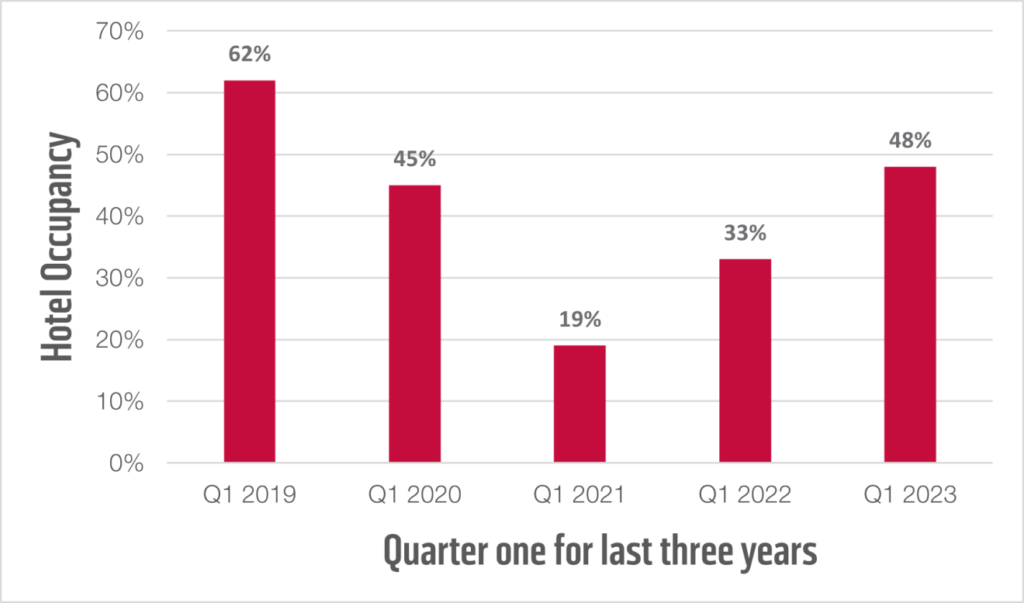
Downtown Chicago hotel occupancy remains below pre-pandemic levels
Occupancy trends highlight this gap clearly.
Data from STR, a widely relied-upon source for hotel performance metrics, shows that downtown Chicago hotel occupancy remains about 9 percent below 2019 levels. While the difference may seem modest, even small occupancy gaps can materially affect hotel revenue and profitability.
Lower occupancy reduces room nights and ancillary income and limits a property’s ability to absorb rising operating costs. These pressures flow directly through to NOI.
NOI Has Not Fully Recovered
NOI recovery lag vs. assessment growth
Revenue has improved since pandemic lows, but NOI has not kept pace for many Cook County hotel assets.
Recent market data shows NOI levels remain roughly 12 to 15 percent below pre-pandemic benchmarks for many properties. Operating expenses have grown faster than revenue, and margins remain tight even where average daily rates have increased.
Because NOI drives value, assessments that assume stabilized income risk overstating current market value. In these situations, an NOI-based hotel appraisal can help clarify whether assessed values reflect actual income rather than projected recovery.
Ongoing Operating Pressures
Hotels continue to face operational challenges that broad valuation models often understate.
Owners still contend with staffing shortages that push labor costs higher. Insurance, utilities, and vendor expenses have increased, while some properties have adjusted amenities or service levels in ways that affect demand. Convention and group travel have improved, but it has not fully normalized across all segments.
These conditions directly affect cash flow. When assessments overlook them, valuations can drift away from market reality.
Cap Rates and the Cost of Risk
Cap rate selection remains another area where assessments and market conditions diverge.
Some valuation models assume cap rates will return to pre-2020 levels. Investors and lenders, however, continue to price in higher risk for many urban hotel assets. Revenue volatility, financing constraints, and uncertainty around long-term demand patterns continue to influence pricing decisions.
A market-supported hotel cap rate analysis helps determine whether risk premiums used in assessments align with current investor expectations.
How NOI-Based Appraisals Are Being Used
Property tax attorneys increasingly rely on NOI-based appraisals to challenge hotel assessments in Cook County.
These analyses focus on trailing NOI, market-supported cap rates, documented occupancy trends, and property-specific operating conditions. This approach shifts valuation discussions away from projections and back toward current performance.
In one recent case, a hotel owner secured a 19 percent reduction in assessed value after demonstrating that recovery assumptions embedded in the assessment overstated current market value. This strategy has become increasingly effective in Cook County hotel property tax appeals, where income assumptions often drive valuation disputes.
What to Watch Heading Into 2025
As assessments continue to reflect optimistic recovery assumptions, hotel owners benefit from taking a closer look at how assessors value their properties.
Key questions include whether assessments align with current NOI rather than projected NOI, whether cap rates reflect today’s risk environment, and whether occupancy and operating costs receive realistic treatment.
When those answers remain unclear, a review can help identify potential exposure.
A Practical, Data-Driven Approach
We have prepared a reference guide that outlines 2024 and 2025 hotel cap rates, occupancy recovery trends, and valuation considerations specific to Cook County.
As assessed values rise faster than income, careful analysis and realistic assumptions remain critical. Owners who ground valuation discussions in current market data place themselves in a stronger position.
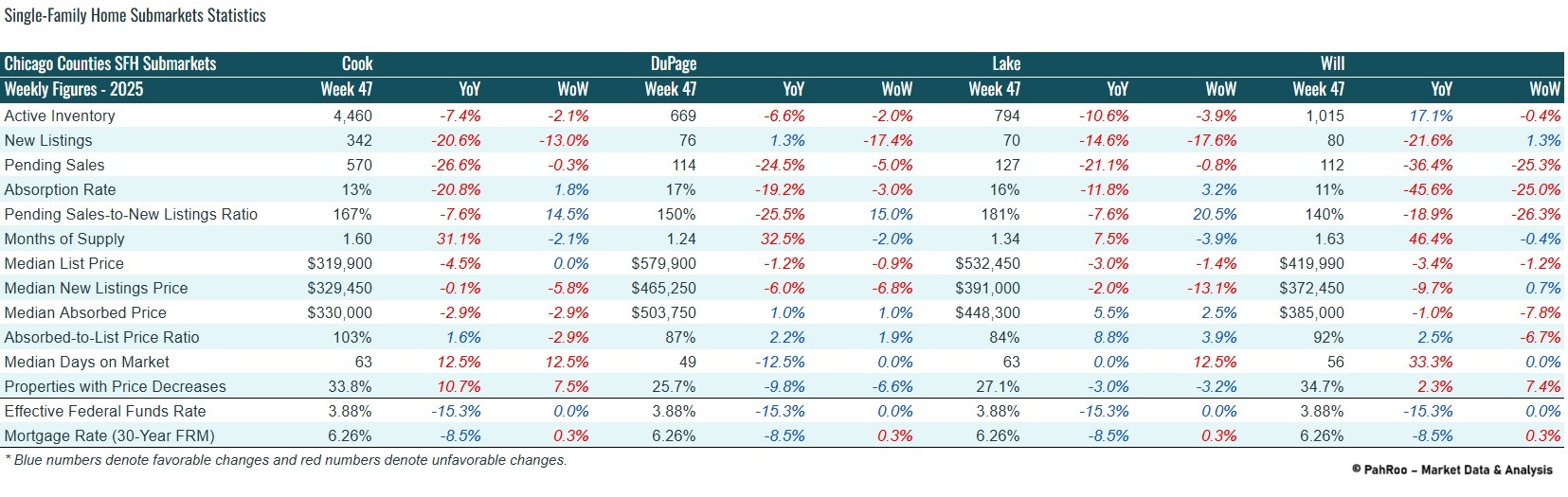
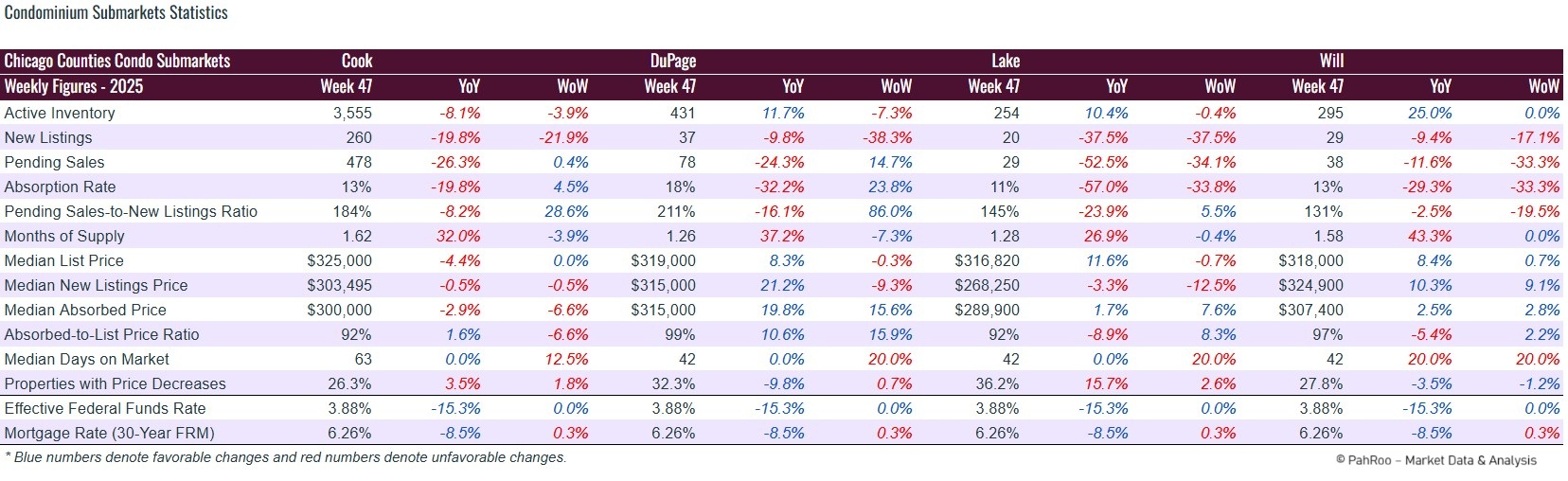
The Chicago real estate market continues to cool as we approach the end of 2025, and the latest weekly data shows a clear shift in both buyer and seller behavior. For the week ending November 21, 2025, new listings dropped sharply, pending sales continued their decline, and days on market rose across many Chicago counties. Whether you’re planning to buy, sell, or invest, understanding these trends can help you make smarter decisions.
This week’s update covers Cook, DuPage, Lake, and Will Counties, summarizing what changed, why it matters, and how you can use the data to your advantage.
Inventory Tightens as New Listings Decline
Across most Chicago-area counties, the number of homes for sale continues to shrink. According to the data in the report:
Single-family new listings dropped as much as 20.6% in Cook and 21.6% in Will County.
Condo listings declined by nearly 20% in Cook and 37% in Lake County.
Active inventory fell in Cook, DuPage, and Lake for single-family homes.
The only exception is Will County, which showed a 17.1% increase in active single-family inventory, a sign of local shifts or catch-ups from earlier shortages.
What's In It For You
If you’re a seller in Cook, Lake, or DuPage County, you’re competing with fewer listings, giving your home more visibility. Buyers, however, may find fewer options and more competition in certain neighborhoods.
Sellers can benefit from a professional appraisal to understand how current pricing trends impact their latest market value.
While rates are lower than last year, they remain high enough to cool buyer activity. This aligns with the slower transaction volume and longer days on market. Current rate trends can be tracked through the Freddie Mac PMMS and Federal Reserve rate updates.
Pricing Trends: Softening but Strategic
Price behavior is mixed:
Single-family median list prices fell 1–4.5% across all counties.
Condos saw more price stability, with DuPage and Lake showing YoY gains in median list and absorbed prices.
Many submarkets also had higher percentages of price reductions, indicating active price negotiations.
What's In It For You
Buyers may find more room to negotiate.
Sellers should price competitively from the start to avoid unnecessary reductions.
Homes Take Longer to Sell
Days on market is a clear indicator of market speed:
Single-family DOM increased by 12–33% in Cook, Lake, and Will.
Condos showed similar patterns, with many counties seeing 20% increases.
As shown in the Market Health tables, the slower pace reflects cautious buyers and the need for competitive pricing.
Actionable Insights for Today’s Market
Buyers → More negotiation power, slower pace, better value opportunities.
Sellers → Less competition in some counties but must price strategically.
Investors → A cooling market may present buying opportunities, especially where inventory is rising (e.g., Will County).
The Market Wrap-Up
The Week 47 Chicago real estate update reveals a market adjusting to interest rates, shifting consumer confidence, and evolving supply-and-demand dynamics. Well-priced, move-in–ready homes continue to attract attention, but buyers are taking their time, making data-driven strategies essential for both sides of the transaction.
To understand how these trends affect your plans, request an appraisal or get your home’s valuation to see your standing in the current market.
If you advise property owners, investors, or developers in Cook County, there’s a good chance you’ve heard of the county’s tax incentive programs, but surprisingly few people are actually taking advantage of them.
That’s a missed opportunity. In 2025 and beyond, these programs could become even more valuable as financing tightens and redevelopment projects face higher costs. Some of these incentives can cut property tax assessments by up to 90% for as long as 30 years and yet, they’re often left on the table.
Understanding these programs isn’t just about saving money. It’s about helping your clients make smarter, more strategic investment decisions.
Class 8 Micro: A 30-Year Tax Break for Small Businesses
Let’s start with one of the most underutilized tools: the Class 8 Micro Program.
This incentive offers a 10% assessment rate for up to 30 years for qualifying small businesses in designated “MICRO” districts. In plain terms, it can dramatically reduce property taxes, freeing up cash that can be reinvested into the business or property.
For advisors working with local entrepreneurs, small business owners, or investors eyeing redevelopment opportunities, this could be the edge that makes a deal possible.
Class 7d: Revitalizing Communities Through Grocery Incentives
Another incentive that’s quietly driving impact is the Class 7d grocery store program.
Designed to encourage grocery stores to open in underserved “food desert” areas, it offers similar tax relief to qualifying projects. It’s a win-win:
For communities, it brings fresh food access and local jobs.
For investors and developers, it lowers costs and aligns with the County’s equity-driven investment strategy.
If you’re advising clients on retail development, this program offers both financial advantage and social impact, something your clients will appreciate.
Post-COVID Incentives: What’s Changing Now
Some short-term programs introduced during COVID, like SER and TEERM, are winding down. But their influence hasn’t disappeared. They’ve changed how incentive renewals and compliance are managed, often introducing more documentation, review, and monitoring steps.
That means these aren’t simple DIY applications. Each program typically requires:
Municipal resolutions
Labor and wage compliance
Ongoing reporting and re-certification
In short, it’s not just about knowing the incentive exists, it’s about navigating the process effectively. That’s where your role as an advisor or tax professional becomes essential.
Why Timing and Guidance Matter
More clients are asking questions like: “Does this deal qualify for a Class 7 or 8 incentive?”
The advisors who can confidently answer that, or better yet, identify the opportunity before the client does, are the ones adding the most value.
By spotting eligibility early, you’re not only helping your clients save on taxes but also strengthening your advisory relationship. And in today’s competitive environment, that insight can set you apart.
Next Steps: Don’t Let Incentives Slip Away
If you’re advising a client on a redevelopment or acquisition in Cook County, now is the time to revisit the tax-incentive options. At PahRoo Appraisal & Consultancy we help property owners, investors and advisors evaluate eligibility for the Class 7, Class 8 and Micro programs.
For the official eligibility requirements, the Cook County Assessor’s Office maintains a full list of incentives and application forms.
Don’t let this kind of savings slip away, claim your tax-break advantage now and turn opportunity into client value.
Did you know? Your home’s appraised value can shape everything from your loan approval to your interest rate and whether you’ll need mortgage insurance. If you’re buying or refinancing in Chicago, the right appraisal helps you qualify for the financing you want on terms that work for your budget.
How a Chicago Home Appraisal Affects Your Loan
An appraisal is an independent, professional opinion of market value used by lenders to help size the loan. It compares your property to recent nearby sales, factors in location and condition, and reflects current market trends. In short: the appraised value is a key input your lender uses to determine how much they’re willing to lend and under what conditions.
Why Your Appraisal Value Impacts LTV, Rates & PMI
Your appraised value drives your loan-to-value (LTV) ratio, which is the loan amount divided by the appraised value. A lower LTV generally means stronger financing options often better rates and, for many conventional loans, the ability to avoid or remove private mortgage insurance (PMI). A higher LTV can limit your choices, add PMI, or require additional cash to close. That’s why accuracy and local market expertise are so important.
Chicago Home Appraisal: Key Factors That Influence Value
Comparable Sales (“Comps”): Recent, nearby, similar properties set the benchmark.
Condition & Updates: Clean, well-maintained homes with quality improvements can support higher value.
Location & Amenities: School districts, transit, parks, and neighborhood trends matter.
Market Velocity: Inventory levels and days-on-market affect how comps are weighed.
If Your Chicago Home Appraisal Comes In Low
It happens. If value lands below the contract price, you and your agent can consider options like seller concessions, a price reduction, or additional cash. In some cases, your lender may offer a reconsideration of value process if there are material issues with comps or data. Either way, a clear, well-supported report keeps decisions grounded in facts.
How Local Chicago Appraisal Expertise Helps You
Chicago is a neighborhood-by-neighborhood market. Our appraisers bring deep, local insight, understanding how a block’s housing stock, school boundaries, or the latest transit extension can shift value. We apply rigorous, unbiased methods and communicate clearly with your lender so you can move forward with confidence.
Unbiased, credible reports: Built to meet lender guidelines and withstand underwriting review.
Neighborhood-level detail: Comps and adjustments reflect real, local dynamics.
Transparent communication: We explain the “why” behind the value so you’re not left guessing.
How to Prepare for a Chicago Home Appraisal
Tidy and repair: Fix obvious items (leaks, loose rails), declutter living areas, and ensure easy access.
List improvements: Provide dates and details (roof, HVAC, windows, kitchens/baths, energy upgrades).
Share your comps: If you or your agent have relevant recent sales, have them ready for consideration.
Highlight location perks: New amenities, school changes, or neighborhood projects can be value-positive.
Know Your Appraisal Rights & Resources
You’re entitled to a copy of the appraisal used in your mortgage review, and you should read it carefully.
If you’re buying, selling, or refinancing in Chicago, partnering with a local expert can make a measurable difference. An accurate, defensible report helps align expectations, reduce friction with underwriting, and set you up for better loan terms.
Who orders the appraisal?
Typically the lender orders it through an appraisal management process to ensure independence.
Can I challenge an appraisal?
If there are material errors or stronger comps, your lender may consider a reconsideration of value request.
Ask your loan officer for their process.
Do I always need an appraisal?
Most mortgages do, though certain streamlined or special-program refinances may receive appraisal waivers
at the lender’s discretion.
Chicago’s suburban housing market in September 2025 showed mixed signals. Buyers and sellers across Cook, DuPage, Lake, and Will Counties experienced different conditions in pricing, inventory, and sales activity. Here’s what you need to know if you’re planning to buy or sell this fall.
Single-Family Trends
Inventory & New Listings
In Cook County, active inventory dropped 4.9% year-over-year, limiting buyer choices. DuPage saw a sharper decline, with listings down 33.8%. Meanwhile, Lake County offered some relief with a 21.2% increase in new listings, and Will County surged with 26.6% more homes on the market.
What this means for you: Buyers will find more options in Will and Lake Counties, while DuPage remains tight and competitive.
Buyer Demand & Pending Sales
Pending sales were down across the board: Cook (-18.6%), DuPage (-15.4%), Lake (-20.8%), and Will (-26.2%). This shows softer buyer demand despite some week-to-week improvements.
Takeaway: Sellers should be prepared for longer market times and more negotiations.
Home Prices & Value Trends
Prices showed a mixed picture. Cook’s median list price fell 4.9% to $341,400. DuPage held steady with a 2.6% increase to $624,900. Lake dropped 6.6% to $559,900, while Will’s absorbed price slipped 11.3% to $385,000.
What this means for you: Buyers in Lake and Will may see more negotiating room, while sellers in DuPage are holding stronger ground.
Chicago Condo Market 2025 – Suburban Trends
Inventory & Seller Activity
Cook’s condo inventory shrank by 7.5% with fewer new listings, making it harder for buyers to find options. By contrast, DuPage saw a 15.5% increase, and Will County jumped 41.7%, suggesting sellers are more active there.
Takeaway: Buyers have the most choices in Will and DuPage, while Cook remains tight.
Sales & Market Absorption
Pending sales fell in every county, with Cook down 26% and DuPage down 13.2%. Absorption rates also dropped, especially in DuPage (-24.8%) and Will (-34.9%), showing slower turnover.
Condo Pricing Insights
Prices varied: Cook dipped 6% ($315,000), while DuPage rose 10.8% ($299,000). Lake and Will saw modest increases of 1.1% and 3.8%, respectively.
What this means for you: Buyers in Cook may have more leverage, while DuPage remains competitive with rising condo prices.
Chicago Housing Market 2025 – Buyer & Seller Outlook
For Buyers: Will County (homes) and Cook County (condos) present more opportunities thanks to increased inventory or softer prices. Patience could give you an edge in negotiations.
For Sellers: DuPage offers stronger pricing power. Sellers in Will and Lake should be flexible to stay competitive in slower markets.
Financing: Mortgage rates are still elevated around 6.26%. While the Fed funds rate dropped, affordability remains tight. This keeps buyers cautious but creates room for negotiation.
Here’s the bottom line on what the numbers mean this month:
Will County: More homes are on the market and prices are softer, which creates opportunities for buyers to negotiate.
Chicago Housing Market Update: What’s Really Happening This Month
The Chicago-area housing market is cooling as we move through late summer 2025. Across Cook, DuPage, Lake, and Will counties, homes are taking longer to sell, buyers have more room to negotiate, and sellers are facing tougher decisions on pricing.
So, what does that mean for you if you’re buying, selling, or investing this year? Let’s break it down.
What You Need to Know About the August 2025 Market
More Homes on the Market – Inventory is climbing in most counties, giving buyers more options.
Slower Sales – Pending sales dropped across the board, with DuPage and Cook seeing the steepest declines.
Buyer’s Market – Absorption rates fell below 20% everywhere, signaling buyers are firmly in control.
Condo Resilience – Cook County’s condo inventory is actually shrinking, even as suburban counties flood with new listings.
Nationally, home sales have also slowed, with the National Association of Realtors reporting a similar cooling trend across major metro areas.
Curious about how these trends impact appraisals? Check out our FAQ page for quick answers.
County-by-County Breakdown
Cook County
Cook County is still the most affordable entry point in the metro area, with the median list price at about $339,000. Inventory is holding steady, which means buyers here can find options without the crazy bidding wars of the past few years.
DuPage County
Despite the market cooldown, DuPage is holding strong. With a median list price near $620,000 and shrinking inventory, this remains one of the most competitive submarkets.
Lake County
Lake County sits somewhere in the middle. Prices have softened a bit, and sales are slower than last year, but not dramatically so.
Will County
Will County is where the shift is most obvious. Inventory jumped 25% year over year, while buyer activity slowed way down. Homes are sitting longer, and price cuts are becoming more common.
What About Condos?
While single-family homes are cooling quickly, condominiums tell a different story. Cook County condo inventory actually dropped (-3.8% YoY), making the downtown and city-adjacent condo market more stable.
In contrast, suburban condo inventory, especially in Will County (+48.6%) is rising fast, creating more options for buyers outside the city.
What This Means for Buyers and Sellers
For Buyers: This is one of the best times in years to negotiate. More listings, longer days on market, and softer pricing trends put you in control.
For Sellers: Pricing matters more than ever. Overpricing can lead to longer time on market and forced price cuts. A professional appraisal can help you set the right price from day one.
With mortgage rates hovering around 6.5%, according to the latest Freddie Mac survey, buyers are balancing higher borrowing costs with increased inventory.
Looking for guidance on how appraisals support real estate decisions? Explore our Appraisal Services page.
PahRoo’s Take: Confidence Through Clarity
At PahRoo Appraisal & Consultancy, we understand how local market shifts impact your property’s value. Our certified appraisers bring Chicago-specific expertise and unbiased valuations you can trust, whether you’re buying, selling, refinancing, or managing an estate.
Chicago housing market Aug 2025 update: buyers are gaining leverage as inventory rises and sales momentum cools across Cook, DuPage, Lake, and Will Counties. If you’re planning to buy, sell, or invest, this month’s numbers point to real opportunities.
Chicago Housing at a Glance for August 2025
Buyer advantage grows: Pending sales are down year over year across all four counties, easing competition.
County differences matter: DuPage remains the strongest on pricing, Cook offers the most affordability, Will shows the largest inventory build.
Condo stability in the city: Cook County condo inventory has tightened compared with last year, contrasting with suburban trends.
Rates keep pressure on budgets: The 30-year fixed hovers in the mid-6% range, moderating demand but opening room to negotiate.
County Snapshots
Cook County
Most affordable entry point. Median list price around the mid-$300Ks, with the largest share of total inventory in the metro. Condo inventory has declined year over year, making the attached market comparatively tighter for buyers.
DuPage County
Strongest pricing resilience. Median list price leads the region. Inventory has contracted versus last year, keeping competition relatively firm for well-presented homes.
Lake County
Balanced but steady. Pending activity shows smaller year-over-year declines than Cook or DuPage, signaling relatively stable demand in select submarkets.
Will County
Most selection for buyers. Active inventory is up sharply year over year while absorption cooled. Sellers should price to the market and prepare for longer days on market.
Mortgage Rates & Affordability
With the 30-year fixed around 6.58%, monthly payments remain elevated versus the recent past. For prepared buyers, this environment can translate to less bidding pressure and better terms.
What This Means for You
Buyers: Compare more homes, negotiate repairs/credits, and lock financing proactively.
Sellers: Price right from day one; consider strategic concessions instead of later price cuts.
Investors: Normalizing conditions after 2020–2024 create more rational entry points.
Why an Appraisal Matters Right Now
In a shifting market, precise value is your edge. A professional appraisal from PahRoo Appraisal & Consultancy, LLC gives you a data-driven view of true market value before you list, bid, refinance, or strategize.
Conditions tilt toward buyers as absorption rates trend lower and months of supply rise versus last year. Well-priced homes still move, but negotiation power has improved.
Which county is most affordable?
Cook County typically offers the lowest median list price among the four major counties, providing more accessible entry points for first-time buyers.
What should sellers do right now?
Lead with market-right pricing, optimize presentation, and consider targeted concessions (closing credits or repair budgets) to protect your timeline and net.
Need clarity before you act?Book an appraisal with PahRoo to move forward with confidence in the Chicago housing market Aug 2025.